Loading NuWatt Energy...

We use your location to provide localized solar offers and incentives.
We serve MA, NH, CT, RI, ME, VT, NJ, PA, and TX
Loading NuWatt Energy...
NuWatt designs, installs, and manages solar, battery, heat pump, and EV charger systems across 9 states. One company, one warranty, one point of contact.
Get a Free QuoteTexas extreme heat makes shade a premium amenity. Bundle solar carports with EV charging for federal 30C credit (30% up to $100K/location), stacked with the solar ITC. ERCOT demand management with battery. C-PACE financing available in Austin, Dallas, Houston, and San Antonio.
Solar ITC
30%
On carport system
30C EV Credit
30%
Up to $100K/location
Charging Revenue
$0.25-$0.45
Per kWh charged
Shade Value
Premium
TX heat amenity
A solar carport + EV charging bundle combines a covered parking structure with integrated solar panels and electric vehicle charging stations. In Texas, this bundle is particularly valuable because extreme heat (100F+) makes shaded parking a premium amenity. The federal 30% ITC applies to the solar carport, while the separate 30C credit provides 30% (up to $100,000/location) for the EV charging equipment. With C-PACE financing available in Austin, Dallas, Houston, and San Antonio, projects can be cash-flow positive from day one. Revenue streams include solar energy savings ($0.06-$0.11/kWh offset), paid charging ($0.25-$0.45/kWh), and demand charge reduction through battery storage.
The Texas climate creates a unique value proposition for solar carports that does not exist in most other states. When summer temperatures regularly exceed 100F and parking lot surfaces reach 140-160F, the shade provided by a solar carport is not a luxury — it is a functional necessity that customers, tenants, and employees actively seek out. This is fundamentally different from Northeast states where carports provide weather protection but the shade amenity value is minimal.
The growing Texas EV market amplifies this value. Tesla's Gigafactory in Austin has catalyzed EV adoption across the state, and Texas now ranks among the top five states for EV registrations. Commercial property owners who install EV charging attract and retain this growing customer segment. Bundling solar carports with EV charging creates a triple-value proposition: shade for parked vehicles, clean energy production to offset electricity costs, and revenue from paid charging services.
Texas also has no state-level EV charger incentive program, making the federal Section 30C credit (30% up to $100,000 per location) the primary financial incentive for EV infrastructure. This credit is separate from the solar ITC and stacks on top of it — meaning the solar carport qualifies for the 30% Section 48/48E ITC while the EV charging equipment qualifies for the 30C credit. Combined with MACRS depreciation on both components, the effective cost reduction can exceed 50%.
For carport-only ROI analysis, see our Solar Carport & Canopy ROI Calculator. For an overview of Texas commercial solar economics, see our Commercial Solar Texas 2026 guide.
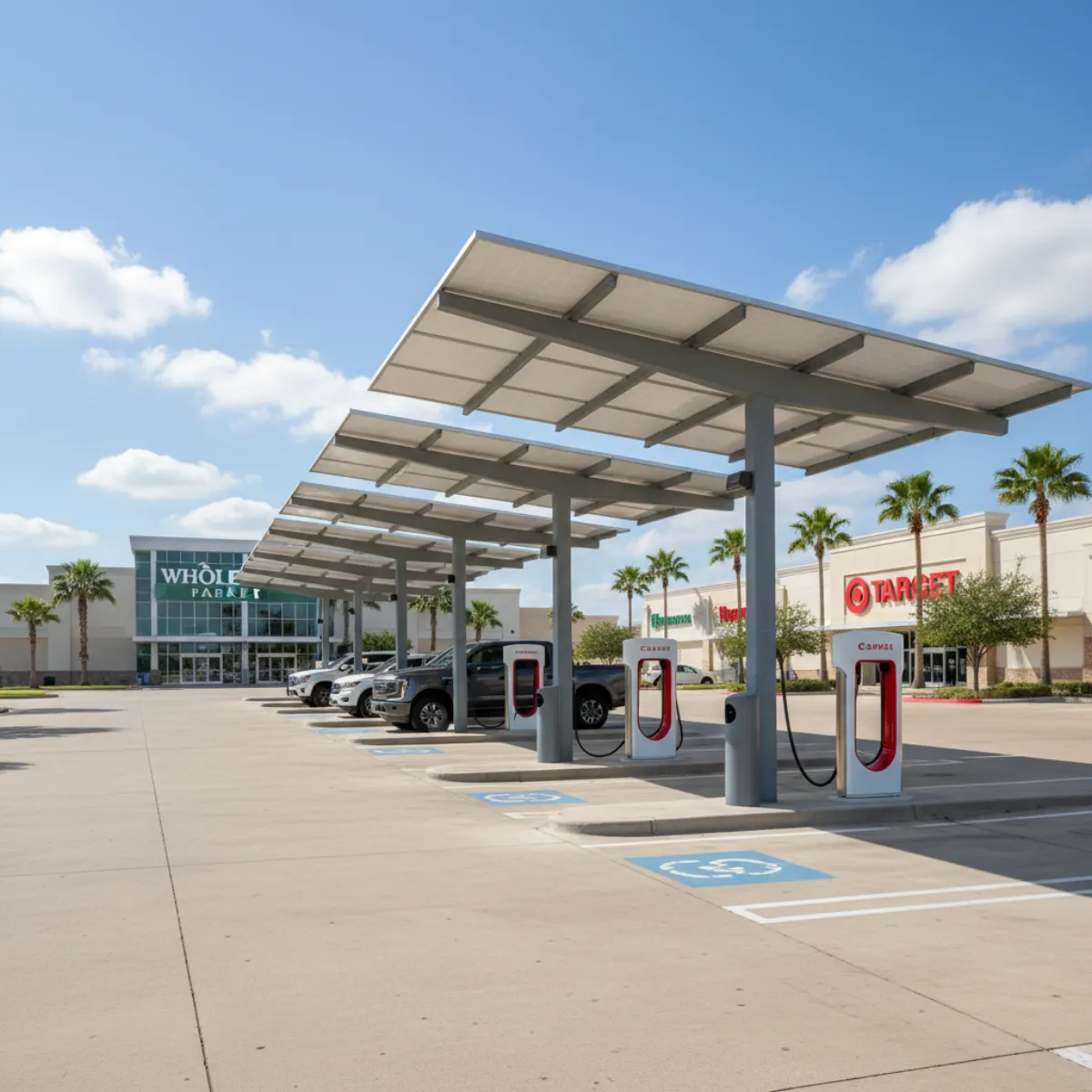
A solar carport + EV charging installation at a Texas commercial property. Shade, clean energy, and EV revenue in one investment.
The solar carport + EV charging bundle qualifies for multiple federal tax incentives that stack together. Because Texas has no state income tax, these federal credits represent the entire tax benefit — making it critical to maximize every available federal incentive.
The solar carport structure and panels qualify for the commercial ITC. The 30% base rate applies with prevailing wage compliance for systems >1 MW. Additional adders: +10% domestic content, +10% energy community, +10-20% low-income. Applied to the full cost of the solar carport structure and PV equipment.
Example: $420,000 solar carport x 30% = $126,000 ITC. With domestic content: $420,000 x 40% = $168,000.
The 30C Alternative Fuel Vehicle Refueling Property Credit covers 30% of EV charging hardware and installation costs, capped at $100,000 per location. This is separate from the solar ITC and stacks on top of it. Qualifying locations must be in a low-income census tract or non-urban area for the full $100,000 cap. Other locations are limited to $1,000 per port.
Example: $130,000 EV equipment x 30% = $39,000 credit (if qualifying location).
Both the solar carport and EV charging equipment qualify for 5-year MACRS depreciation. OBBBA restored 100% first-year bonus depreciation on a permanent basis, so the full depreciable basis is expensed in Year 1. The depreciable basis is reduced by 50% of the ITC amount. At the 21% corporate federal tax rate, MACRS provides substantial first-year tax savings. No TX state income tax benefit — federal only.
Example: Combined depreciable basis ~$485,000 x 100% (Year 1 bonus) x 21% = ~$101,850 Year 1 tax savings.
Choosing between Level 2 and DCFC stations has major implications for cost, demand charges, and the need for battery storage in the ERCOT market.
Power per Port
7.2-19.2 kW per port
Charging Speed
25-80 miles of range per hour
Total Cost per Unit
$5,500-$16,000
Revenue per kWh
$0.25-$0.35/kWh charged
Demand Impact
Low — 7-19 kW per port, manageable without battery
Best For
Workplaces, retail (2+ hour dwell time), multifamily, municipal lots
Most cost-effective option for destinations where vehicles park for extended periods. Lower demand charges. Pairs well with solar carport without battery storage. Ideal for TX workplaces and shopping centers where customers park 1-4 hours.
Power per Port
50-350 kW per port
Charging Speed
150-250 miles of range per hour
Total Cost per Unit
$60,000-$250,000
Revenue per kWh
$0.35-$0.45/kWh charged
Demand Impact
High — 50-350 kW per port can trigger massive demand charges
Best For
Convenience stores, gas stations, highway corridor stops, fleet depots
Fastest charging but highest cost and demand charge impact. Battery storage is essential for DCFC to manage ERCOT demand charges. A single 150 kW DCFC session can spike your monthly peak demand by $1,200-$2,250 at $8-$15/kW. Solar + battery mitigates this.
In ERCOT territory, demand charges of $8-$15/kW per month are common for commercial accounts. A single 150 kW DCFC session can add $1,200-$2,250 to your monthly electric bill if it sets a new peak demand. Battery storage is essential for DCFC installations in Texas to buffer demand spikes. Without battery storage, DCFC demand charges can consume most or all of the charging revenue. See our Commercial Demand Charge Battery Calculator.
Charge EV drivers $0.25-$0.45/kWh. TX has no state cap on charging rates. Revenue depends on utilization — urban locations with high traffic see 3-6 sessions/day per port.
Per L2 Port/Year
$2,500-$6,000
Per DCFC Port/Year
$15,000-$50,000
Solar carport offsets your facility electricity consumption at $0.06-$0.11/kWh. Any excess can be sold back through your REP buyback plan.
Per 100 kW Solar/Year
$9,000-$17,000
Solar + battery reduces peak demand charges. ERCOT 4CP reduction saves $2-$8/kW/month in transmission costs. Demand charges of $8-$15/kW are common for commercial TX accounts.
Annual Savings
$5,000-$25,000
Covered parking with solar and EV charging increases property value and tenant/customer attraction. TX extreme heat makes shaded parking a major amenity.
Property Value Impact
5-10% lease rate premium
A North Dallas retail plaza in Oncor territory installed a 200 kW solar carport with 8 Level 2 chargers and 1 DCFC station, paired with a 100 kWh battery system for demand management. This case study illustrates the financial performance of a fully bundled installation.
Location
North Dallas (Oncor territory)
Solar System
200 kW carport solar
EV Chargers
8 Level 2 (19.2 kW each) + 1 DCFC (150 kW)
Battery Storage
100 kWh battery for demand management
Total Cost
$650,000
Simple Payback
5.3 years
Solar ITC (30%)
30% = $126,000 (solar carport)
30C EV Credit
30C credit = $39,000 (EV charging, 30% of $130K)
MACRS Year 1
MACRS Year 1 deduction: ~$39,000 tax savings
Solar Savings
$30,000/yr
Charging Revenue
$42,000/yr
Demand Savings
$12,000/yr
Total Annual
$84,000/yr
Financing: C-PACE (20-year term, 7.5% interest)
Monthly PACE Payment: $3,580
Monthly Revenue/Savings: $7,000
Net Monthly Cash Flow: +$3,420/month net positive from day one
For C-PACE financing details including qualifying jurisdictions and application process, see our TX C-PACE Commercial Solar Guide. For EV charger bundle options across Texas, see our Solar + EV Charger Bundle Guide.
Solar carports in Texas must be engineered for local wind conditions, which vary dramatically from the Gulf Coast to the interior. Carport structures are more exposed to wind than rooftop solar systems because they are elevated and open on multiple sides, creating wind loading patterns that require careful structural engineering.
Gulf Coast installations (Houston, Corpus Christi, Galveston, Beaumont) require designs rated for 130-150 mph wind speeds per ASCE 7 wind speed maps. This means heavier steel columns, deeper foundations, and potentially cantilevered designs with reinforced moment connections. Interior Texas installations (DFW, Austin, San Antonio) typically require 90-115 mph wind ratings — still substantial, but allowing lighter and less expensive structural designs.
The additional structural cost for hurricane-rated carports adds approximately 15-25% to the carport structure cost compared to interior TX installations. However, the higher wind rating also provides greater resilience against the severe thunderstorms and hail events that affect all of Texas, making it a defensible investment even for non-coastal properties in hail-prone areas.
Grid reliability is another factor unique to Texas. Following ERCOT grid events, many commercial property owners view solar + battery as a resiliency investment. A carport solar system with battery storage can provide limited backup power during grid outages, keeping critical loads (POS systems, refrigeration, lighting) operational. This resiliency value is increasingly factored into project economics.
The Section 30C Alternative Fuel Vehicle Refueling Property Credit provides a 30% tax credit for the cost of installing EV charging equipment, up to $100,000 per location (not per charger). This applies to both L2 and DCFC hardware and installation costs. The credit is available through 2032 for properties in low-income census tracts or non-urban areas. For properties in other locations, the credit is limited to $1,000 per port for individuals. The 30C credit is separate from the solar ITC and can be stacked — you can claim 30% ITC on the solar carport and 30C on the EV chargers for the same property.
Stack the 30% ITC + 30C credit + MACRS. C-PACE financing available in Austin, Dallas, Houston, and San Antonio.