Loading NuWatt Energy...

We use your location to provide localized solar offers and incentives.
We serve MA, NH, CT, RI, ME, VT, NJ, PA, and TX
Loading NuWatt Energy...
NuWatt designs, installs, and manages solar, battery, heat pump, and EV charger systems across 9 states. One company, one warranty, one point of contact.
Get a Free QuoteIn Texas, solar carports are not just power generators — they are shade structures that solve a real problem. With parking lots reaching 170F in summer, covered parking is a premium amenity that drives customer traffic, reduces building AC loads, and protects vehicles from hail. Add EV charging and federal tax benefits, and carports become a compelling commercial investment.
Carport Cost Range
$2.80-5.00/W
Including structure
Parking Temp Drop
30-50F
Surface temperature
ITC + MACRS
30-70% + 21%
Federal tax benefits
Effective Payback
5-9 Years
With ancillary value
Texas solar carports cost $2.80-$5.00 per watt (including structure), with payback periods of 5-9 years depending on configuration, location, and ancillary value captured. A 200 kW carport covering 150 spaces costs $560,000-$1,000,000 before incentives. After 30% ITC and MACRS (federal-only, 21% rate), net cost drops to $280,000-$500,000. Beyond electricity generation, Texas carports uniquely add value through extreme heat shade (parking lot surfaces drop 30-50F), adjacent building AC load reduction (8-15%), hail protection, and EV charging revenue. Gulf Coast installations require hurricane-rated structures (+15-25% cost).
In Massachusetts or Connecticut, solar carports are primarily valued for their energy production and any state incentive adders (like the SMART canopy adder in MA). In Texas, there is no state carport incentive — but there is something even more valuable: extreme heat that makes parking lot shade a genuine economic driver.
Texas parking lots are brutally hot. Black asphalt surfaces reach 150-170F in July and August. Vehicle interiors parked in direct sun can exceed 140F within 30 minutes. This is not just an inconvenience — it is a health hazard, a customer experience problem, and a source of significant energy waste as adjacent buildings work harder to cool against the heat island effect of acres of baking asphalt.
Solar carports solve all of these problems simultaneously. They generate electricity, shade vehicles, reduce heat island effect, and create infrastructure for EV charging. The economic value of these non-electricity benefits is often $10,000-$50,000/year for mid-to-large installations, which can reduce the effective payback by 2-3 years compared to electricity value alone.
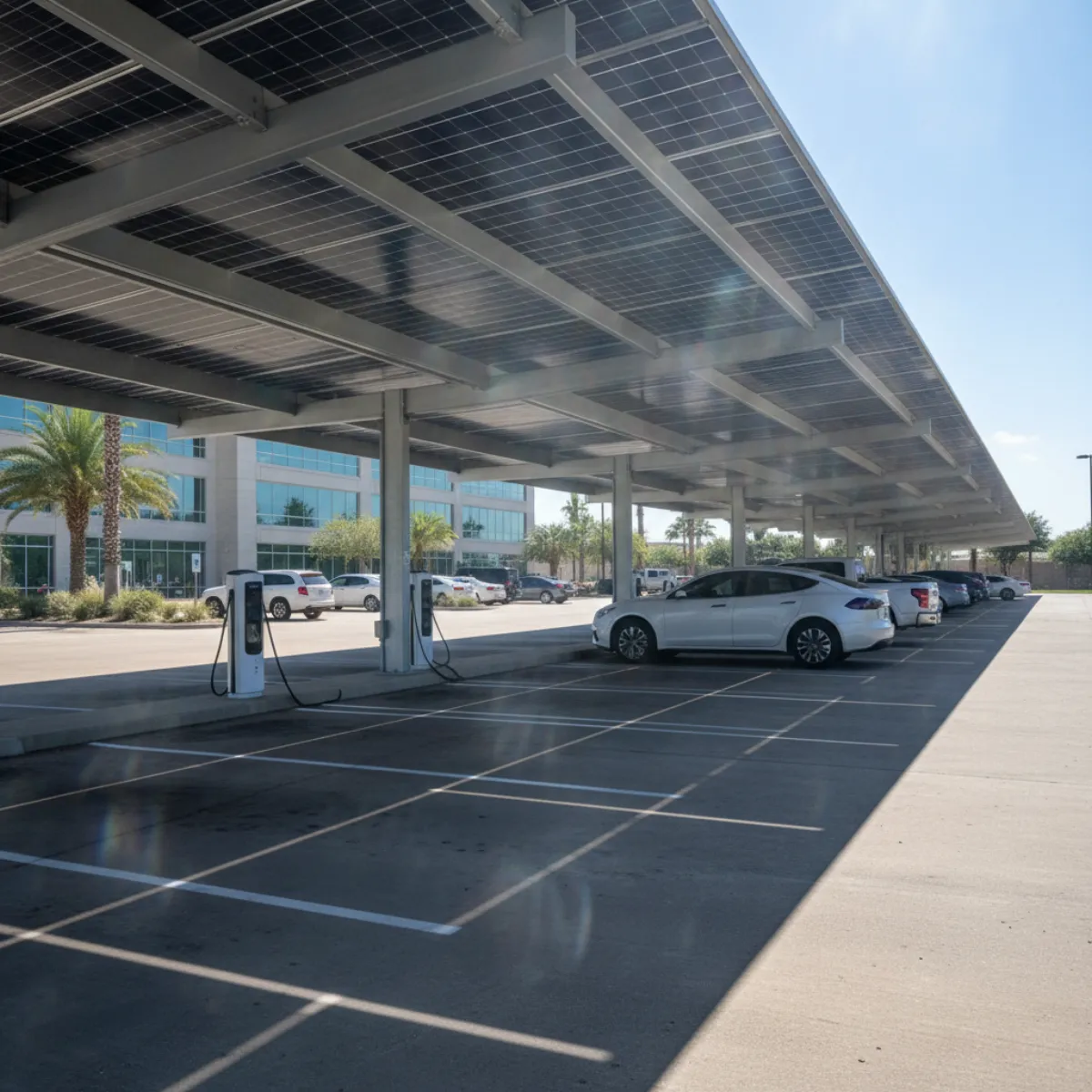
Texas parking lots reach 150-170F surface temperature in summer. Solar carports reduce surface temp by 30-50F and shaded vehicle interior temps by 20-35F. Customers and employees prefer shaded parking — studies show 80% of shoppers choose shaded spots even if farther from the entrance.
Estimated value: $5,000-$25,000/year in customer preference and employee retention value
Heat island effect from unshaded parking lots increases AC load on adjacent buildings by 10-20%. A 200-space carport can reduce building cooling costs by 8-15% by lowering ambient temperature in the parking area. In Texas, where commercial AC runs 8-10 months/year, this is a major operating cost reduction.
Estimated value: $3,000-$12,000/year in reduced AC costs
Texas hail causes $1B+ in annual vehicle damage. Covered parking protects employee and customer vehicles from hail, UV degradation, and bird droppings. Businesses with covered parking see reduced insurance claims and vehicle maintenance complaints. Fleet operators save significantly on vehicle appearance maintenance.
Estimated value: $2,000-$8,000/year in avoided damage claims and fleet maintenance
Texas EV registrations grew 45% in 2025. Solar carports with integrated EV charging create a new revenue stream. Level 2 chargers cost $3,000-$8,000 per station. DCFC (DC fast charging) costs $50,000-$150,000 but generates $500-$2,000/month per station. Solar offsets charging electricity costs, improving margins.
Estimated value: $6,000-$24,000/year per DCFC station
Carport cost varies significantly based on the structural design, which should be selected based on your location (hurricane zone vs. inland), parking layout, and aesthetic requirements.
One center column per section. Most cost-effective for standard parking. Spans one row of parking.
Advantages
Considerations
Best for: Inland TX locations (DFW, Austin, San Antonio), employee parking, single-row layouts
Two columns supporting a cantilevered canopy. Covers two adjacent parking rows with a center driving aisle.
Advantages
Considerations
Best for: Retail lots, hospitals, commercial campuses with double-row parking
Heavy steel structure spanning large areas. Designed for extreme weather. Hurricane and hail rated.
Advantages
Considerations
Best for: Houston/Gulf Coast (hurricane zone), airports, large retail, hospitals requiring maximum protection
Texas spans two distinct weather risk zones that fundamentally affect carport design and cost. The Gulf Coast (Houston, Galveston, Corpus Christi) faces hurricane-force winds that require heavy-duty structural engineering. The inland corridor (DFW, Austin, San Antonio) faces lower wind speeds but significant hail risk from the tornado alley weather pattern. Understanding your zone determines both the structural requirements and the cost premium.
Design Wind Speed
150+ mph design speed
Hail Rating
UL 2703 / IEC 61215 hail rated
Hurricane-rated structures required. Heavier gauge steel, deeper foundations (8-12 ft), stainless steel hardware. Panels must be hail-rated (3-inch hailstone at 88 mph). Building code: ASCE 7-22 Risk Category III or IV for essential facilities.
Design Wind Speed
115-130 mph design speed
Hail Rating
UL 2703 standard + hail endorsement recommended
Standard commercial wind loads but hail insurance is critical. 2-3 inch hailstones common. Consider hail guards or high-hail-rated panels (REC Alpha, Qcells, Canadian Solar HiKu). Insurance should cover hail damage.
Design Wind Speed
105-115 mph design speed
Hail Rating
Standard UL 2703
Standard commercial building codes apply. Lower wind and hail risk. Most cost-effective for carport solar. Standard foundations (4-6 ft). Austin and San Antonio have streamlined commercial solar permitting.
System Size
200-1,000 kW
Coverage
150-750 parking spaces
Cost Range
$600K-$5M
Payback
6-9 years
Customer shade preference drives foot traffic. EV charging attracts premium shoppers. Carport solar visible to customers reinforces sustainability branding. H-E-B, Whole Foods, and Target stores in TX are adding carport solar.
System Size
500-2,000 kW
Coverage
400-1,500 spaces
Cost Range
$2M-$10M
Payback
5-8 years
Patient and visitor shade is critical for health outcomes (heat stroke prevention). 24/7 operations maximize self-consumption. Critical infrastructure benefits from resilience. MD Anderson, Baylor Scott & White, and Methodist hospitals expanding carport solar.
System Size
100-500 kW
Coverage
80-400 spaces
Cost Range
$400K-$2.5M
Payback
7-10 years (PPA structure)
Schools typically use PPA since they cannot claim ITC/MACRS (tax-exempt). Carport shade reduces bus and carpool idle AC use. Educational demonstration value. UT Austin, Texas A&M, and multiple ISDs adding carport solar.
System Size
300-1,500 kW
Coverage
250-1,200 spaces
Cost Range
$1M-$7.5M
Payback
5-7 years
Employee satisfaction from covered parking (major recruitment/retention benefit in TX heat). ESG reporting value. EV charging for employee fleet. Toyota, AT&T, and American Airlines in DFW investing in carport solar.
System Size
1,000-5,000 kW
Coverage
800-4,000 spaces
Cost Range
$5M-$25M
Payback
6-9 years
Massive parking lots with full sun exposure. Traveler shade is premium amenity. EV rental car charging. Dallas-Fort Worth International Airport has one of the largest airport carport solar installations in the US.
Complete commercial solar guide for Texas businesses: ITC, MACRS, financing.
25-year IRR/NPV calculator for TX commercial solar with financing comparison.
Guide to bundling solar with EV charging infrastructure in Texas.
Solar carport costs in Texas range from $2.80 to $5.00 per watt depending on the structural configuration and weather requirements. Single-column T-frames in inland areas (DFW, Austin, SA) cost $2.80-$3.50/W. Double-column cantilever designs cost $3.20-$4.00/W. Hurricane-rated full-span structures for the Gulf Coast (Houston, Corpus Christi) cost $3.80-$5.00/W. A 200 kW carport covering approximately 150 parking spaces costs $560,000-$1,000,000 before incentives. After 30% ITC and MACRS depreciation, net cost drops to $280,000-$500,000.
Our team will evaluate your parking lot, recommend the optimal carport configuration for your TX location (including wind/hail requirements), and model the full ROI with ITC, MACRS, demand charge reduction, and EV charging.