Loading NuWatt Energy...

We use your location to provide localized solar offers and incentives.
We serve MA, NH, CT, RI, ME, VT, NJ, PA, and TX
Loading NuWatt Energy...
Use the free estimator for a preliminary layout, or share your preferred response method with the commercial team. Final feasibility still requires site, utility, and engineering review.
Section 48E begin-construction window closed July 4, 2026; new starts must be placed in service by December 31, 2027
A 6% statutory credit; 30% and additional bonuses require documented eligibility.
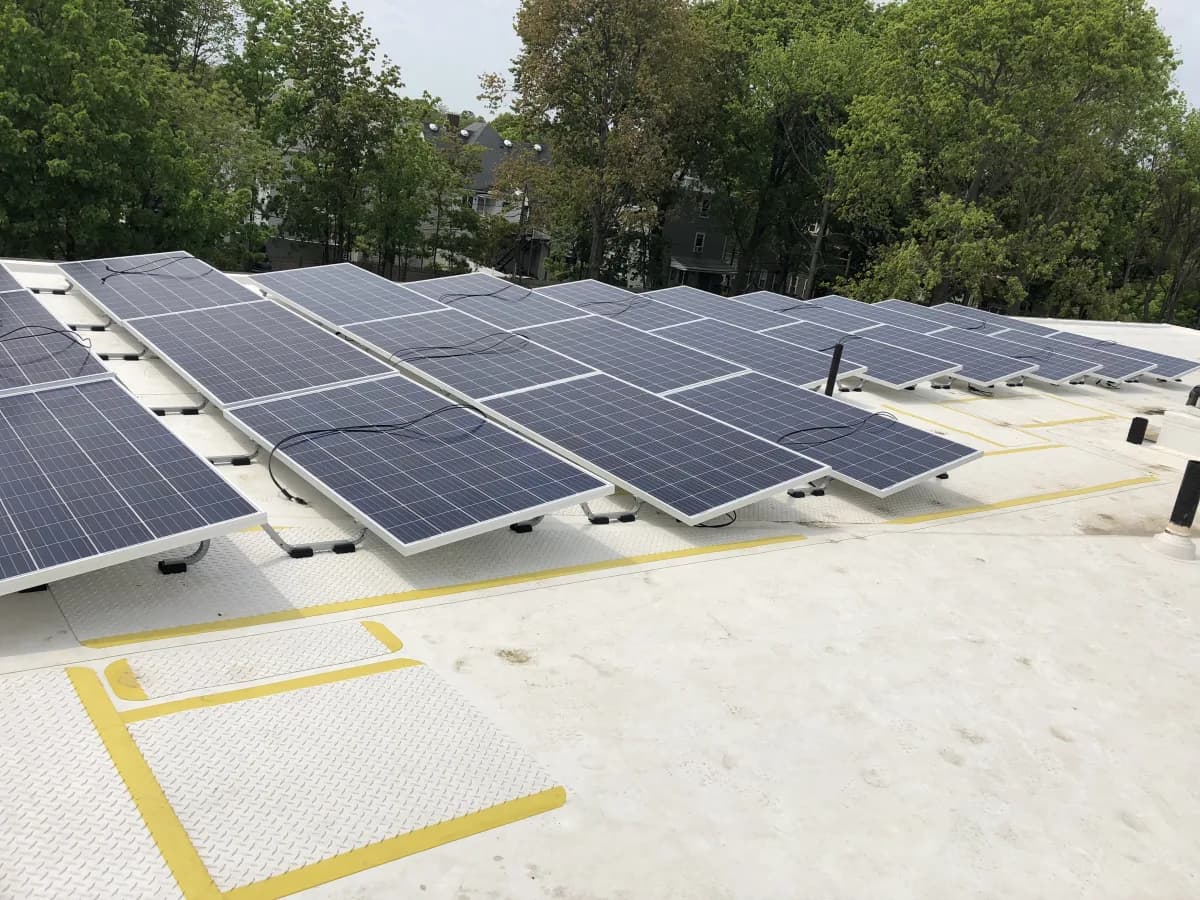
NuWatt installation: Epiphany School, Dorchester, MA.
Section 48E requires eligible timing, ownership and sourcing: a 6% statutory rate, conditional 30% and separately qualified bonuses—not a routine 70%. Use the meter tariff and interval data, not a state average. SMART 3.0 depends on approval and Value of Energy treatment. Full first-year depreciation requires eligible property acquired and placed in service after January 19, 2025. Verify state tax treatment separately; not every commercial purchase is automatically exempt.
Qualified ITC
30%
Max ITC
70%
MACRS Bonus
100%
Electric Rate
Meter-specific
Section 48E Placed-in-Service
New starts: placed in service by December 31, 2027
MACRS Bonus: 100%
Permanent under OBBBA
Windows Are Closing
If you are considering commercial solar, 2026 is the last best year
Important 2026: The residential 25D tax credit is DEAD (expired Dec 31, 2025). But the Section 48/48E commercial ITC is STILL available for commercial projects; new starts generally must be placed in service by December 31, 2027. The system owner claims the ITC, NOT the installer or the business occupying the building (unless the business owns the system outright).
Section 48E has a 6% statutory rate; 30% requires applicable labor conditions or an exception. Each additional bonus requires separate qualification, including its applicable percentage. The system owner claims the credit, not the installer.
Sources for tax and SMART corrections, checked September 4, 2026: IRS Section 48E · DOER SMART 3.0. This date does not represent a new pricing or engineering review.
| Component | Rate | Requirement |
|---|---|---|
| Qualified ITC | 30% | 30% requires applicable wage/apprenticeship compliance or an exception; also verify construction/service dates, PFE restrictions and every claimed bonus |
| Domestic Content Bonus | +10% | Meet domestic content requirements (supply chain verification) |
| Energy Community Bonus | +10% | Project located in a qualifying energy community |
| Low-Income Bonus | +10-20% | Project in low-income community or affordable housing |
| MAX STACKED | Up to 70% | System owner claims the ITC |
Critical: Identify the eligible tax owner separately from the installer and electricity customer. A loan does not itself prevent ownership. PPA and lease benefits depend on the tax structure and contract; customer savings are not guaranteed.
The retained $1.10-$2.55/W DC bands provide scale comparisons, but their current market provenance is unverified. They are legacy planning inputs—not official Massachusetts rates or current NuWatt quotes. Replace them with an itemized bid before calculating project savings, financing or incentives. Roof work, interconnection, service upgrades, storage, labor requirements and equipment origin require separate scope confirmation.
| Tier | Size | Price $/W | Example | Example Cost |
|---|---|---|---|---|
| Small Business | 25-100 kW | $1.80-$2.55/W | 50 kW | $90,000-$127,500 |
| Mid-Size Commercial | 100-500 kW | $1.40-$1.90/W | 250 kW | $350,000-$475,000 |
| Large-Scale | 500 kW+ | $1.10-$1.50/W | 1,000 kW | $1,100,000-$1,500,000 |
Illustration only: 100 kW at assumed $1.85/W = $185,000 gross. If the full cost and usable 30% credit qualify, cost less credit is $129,500; this is not the upfront invoice or a verified market quote.
Prices are estimates before incentives (ITC, MACRS, SMART). Actual costs vary by project complexity, equipment, and site conditions.
Massachusetts offers production-based solar incentives through the SMART (Solar Massachusetts Renewable Target) 3.0 program. These stack on top of the federal ITC and MACRS.
Behind-the-meter commercial rooftop and ground-mount
Rate
Program-year AC size tier; BTM Value of Energy applies
Term
20 years
Use the current DOER program-year schedule and project qualification. Do not add the gross compensation rate to retail bill savings.
Shared solar projects serving multiple off-takers
Rate
Use the project-approved community-solar adder
Term
20 years
For community shared solar projects. Significant additional revenue for developers serving low-income subscribers.
Community-solar and low-income eligibility are not interchangeable. Verify the project category, subscriber requirements and approved adder against the current DOER schedule before forecasting revenue.
| Class | Size | Credit | Notes |
|---|---|---|---|
| Class II | >60 kW - 1 MW | Applicable utility net-metering credit formula; not the whole retail bill | DPU capacity convention applies. Verify cap allocation or an applicable exemption, facility category and tariff. |
| Class III | >1 MW - 2 MW private / >1 MW - 10 MW public | Facility-specific DPU/utility credit formula; not an assumed negotiated wholesale rate | Public/private eligibility differs. SMART limits are separate; municipal electric programs require their own review. |
Depreciation is a deduction, not a rebate. Full first-year bonus treatment requires eligible property acquired and placed in service after January 19, 2025, subject to elections and tax rules. Reduce basis by half the credit; an unused deduction is not cash paid at installation.
| Item | Amount |
|---|---|
| System Cost | $1,000,000 |
| 30% ITC | -$300,000 |
| Depreciable basis (Cost - 50% of ITC) | $850,000 |
| Year 1 Deduction (100% bonus x $850K) | $850,000 |
| Remaining depreciated in later years | $0 |
| Total tax benefit (21% rate) | $478,500 |
Prohibited-foreign-entity and material-assistance restrictions can affect the underlying credit. They are separate from the domestic-content bonus; verify both rules and the applicable documentation.
July 4, 2026
For solar, construction beginning after July 4, 2026 generally requires placed-in-service by December 31, 2027. An earlier start requires documented beginning-of-construction and continuity under the rules applicable to the project; confirm current IRS guidance and court orders with tax counsel; it does not guarantee an extension or a credit. Verify tax and sourcing requirements separately.
To earn the +10% domestic content bonus, projects must verify components meet domestic manufacturing requirements. This requires supply chain documentation.
Start supply chain verification now. Panel and inverter manufacturers must provide origin certifications. Procurement lead times are 4-12 weeks.
Massachusetts is one of the best states in the country for commercial solar. Here is why.
Arithmetic illustration, not a quote or an average business: 100 kW DC, assumed $185,000 cost, assumed 120,000 kWh/year production and full self-consumption at an assumed avoidable value of $0.26/kWh. This is not a published utility tariff. SMART is not added without approval and Value of Energy reconciliation.
100 kW illustrative scenario—not a quote
Assumed gross value: 120,000 kWh × $0.26
Tax benefits depend on eligibility and usability. Verify self-consumption and the avoidable rate against your facility’s data.
Assumptions: usable 30% ITC; depreciable basis = $185,000 − half of $55,500 = $157,250; full first-year deduction only for eligible property acquired and placed in service after January 19, 2025, at an assumed 21% tax rate. The benefit is $33,022.50, not cash received at installation. O&M, insurance, financing, replacements, degradation and escalation are not modeled. Fixed and demand charges do not automatically disappear. Verify tax timing and self-consumption against interval data before calculating payback or ROI. Tax rules checked September 5, 2026: IRS Section 48E / IRS Publication 946.
This is one of the most misunderstood points in commercial solar. The ITC is claimed by the system OWNER, not the installer and not necessarily the business.
Who claims the ITC: The PPA provider (financing company/developer)
How the business benefits: Compare initial payment, energy price, escalation, maintenance and exit costs in the signed contract against the actual utility tariff. Provider tax benefits do not guarantee a customer discount or zero upfront cost.
Best for: Nonprofits, public entities, businesses without tax appetite
Who claims the ITC: The lessor (financing company that owns the system)
How the business benefits: Payments and maintenance depend on the lease. Compare escalation, insurance, roof work, default and purchase or removal obligations; tax benefits are not automatically passed through.
Best for: Businesses wanting predictable costs without ownership complexity
Who claims the ITC: The business (as the system owner)
How the business benefits: The eligible owner evaluates the credit, separately qualified bonuses and adjusted-basis depreciation. Compare actual tax timing, costs and financing; ownership does not guarantee the highest return. Eligible exempt or government owners may evaluate elective pay with registration and filing.
Best for: Profitable businesses with sufficient tax liability
Installation alone does not confer the ITC
The installer is a contractor who performs the installation work. The ITC is claimed by the entity that OWNS the solar system. If an installer tells you they claim the ITC, that is incorrect -- unless they are also the third-party system owner/financier.
Four main paths to finance commercial solar in Massachusetts. Each has different implications for who claims the ITC.
| Type | Who Claims ITC | Upfront Cost | Best For |
|---|---|---|---|
| PPA (Power Purchase Agreement) | PPA Provider | Contract-specific | Nonprofits, public entities, cash-constrained businesses |
| Solar Lease | Lessor (Finance Company) | Contract-specific | Businesses wanting predictable costs without ownership complexity |
| Commercial Loan | Business (if they own the system) | Lender-specific down payment | Profitable businesses with strong tax appetite |
| Cash Purchase | Business | 100% | Well-capitalized businesses seeking maximum ROI |
Recommended timeline to maximize commercial solar benefits in Massachusetts.
Now
Request free site assessments from multiple commercial installers. Compare financing options (PPA, lease, loan, cash purchase).
The instant tool provides a preliminary site screen. Final pricing, scope and eligibility require verification.
Q1 2026
Sign contracts, complete permitting, order equipment. Begin supply chain verification for domestic content bonus.
Window Closed July 4, 2026
For solar, construction beginning after July 4, 2026 generally requires placed-in-service by December 31, 2027. An earlier start requires documented beginning-of-construction and continuity under the rules applicable to the project; confirm current IRS guidance and court orders with tax counsel; it does not guarantee an extension or a credit. Verify tax and sourcing requirements separately.
Q3-Q4 2026
Schedule installation, inspection, permission to operate and program qualification against written milestones. Service date alone does not establish credit or depreciation eligibility; verify acquisition, sourcing, labor and tax requirements separately.
December 31, 2027
For solar starts after July 4, 2026, the general service deadline is December 31, 2027. Meeting it does not guarantee a credit: all other requirements still apply. An earlier start requires evidence and continuity under the rules applicable to the project; confirm current IRS guidance and court orders with tax counsel.
Sector-specific and incentive-specific guides for Massachusetts businesses.
Section 48E remains available for qualifying commercial solar, with a 6% statutory rate and 30% when the higher-rate conditions or an exception are met. Domestic-content and energy-community bonuses can each add 10 percentage points at the higher rate; the 10-20-point low-income bonus requires an allocation and separate eligibility. A 70% combination is a conditional ceiling, not an ordinary project assumption. Solar starting after July 4, 2026 generally must be placed in service by December 31, 2027; an earlier start requires documented beginning-of-construction and continuity compliance, not an automatic 2030 extension. Entity, material-assistance, basis and other restrictions still apply.
The eligible tax owner claims the credit, not the installer merely because it installed the equipment. A business that owns qualifying property can evaluate the credit and applicable tax rules; a PPA or lease provider generally owns the system in third-party arrangements. Any benefit to the customer depends on negotiated payments, escalators and contract terms—not a guaranteed dollar-for-dollar pass-through. Eligible tax-exempt and governmental owners may evaluate elective pay with required registration and filing. Identify the tax owner and the party paying each cost before comparing financing offers.
SMART 3.0 uses program-year compensation schedules and qualified project categories. Verify AC capacity, the applicable utility tariff, approved adders and the Statement of Qualification with DOER. Behind-the-meter Value of Energy affects compensation: do not add a gross SMART rate to retail savings as though both independently pay for the same energy. Model approved program payments, self-consumption and exports consistently, and include operating costs and payment timing. Eligibility for SMART does not establish eligibility for a federal credit or a tax exemption.
MACRS is a depreciation deduction, not a rebate. Eligible solar property may use a five-year recovery period; classification, basis and tax position must be verified. IRS guidance allows 100% bonus depreciation for certain qualified property acquired AND placed in service after January 19, 2025, subject to applicable rules and elections. The acquisition condition matters. Where a 30% investment credit applies, a $100,000 eligible basis becomes $85,000 after the half-credit basis reduction. A deduction produces tax savings only to the extent and at the time it can be used.
The retained comparison spans $1.10-$2.55/W DC, but these are legacy planning inputs whose current market provenance has not been verified—not an official Massachusetts price survey or a current NuWatt quote. At those inputs, the 50 kW row is $90,000-$127,500, the 250 kW row is $350,000-$475,000 and the 1 MW row is $1.1-$1.5 million gross. Keep these scale comparisons separate from a current itemized bid. Roof work, interconnection, service upgrades, mounting, labor compliance and equipment origin must be priced explicitly. Do not automatically subtract credits, depreciation or future SMART receipts from the invoice.
Prohibited-foreign-entity and material-assistance restrictions are separate from the domestic-content bonus and can affect eligibility for the underlying credit, not merely a 10-point adder. IRS Notice 2026-15 provides interim guidance, including material-assistance calculations. Separately assess domestic-content requirements and certification. A country-of-origin label alone is not a complete eligibility determination; retain supplier documentation, relevant cost records and dates. This guide does not establish a universal equipment price premium or certify any product or supplier as compliant.
The Massachusetts DPU guide defines Class I as 60 kW or less and Class II as more than 60 kW through 1 MW. Class III is more than 1 MW through 2 MW for private facilities, with a different public-facility limit of 10 MW. These are net-metering classifications, not SMART project limits. Apply the DPU capacity convention and check cap allocation or an applicable exemption, facility type, utility tariff and credit formula. Credits are not a universal negotiated wholesale rate or a simple retail rate minus the minimum bill. Municipal utility programs must be checked separately.
Massachusetts offers several project-specific paths to value: avoidable utility purchases, qualified SMART compensation and potentially usable federal tax benefits. None guarantees a statewide payback. Confirm the actual meter, tariff, operating schedule, export rules, roof scope and ownership before estimating returns. Property-tax and sales-tax treatment are conditional, not automatic commercial discounts. Compare net annual cash flows after maintenance, insurance, financing and replacement costs, and keep available incentives separate from amounts approved for the particular project. Municipal-service facilities may have different program options from investor-owned utility customers.
Eligible tax-exempt organizations and governmental entities can evaluate elective pay for an eligible Section 48E credit on qualifying property they own; lack of ordinary federal income-tax liability does not restrict them to third-party ownership. IRS pre-filing registration, timely filing, ownership and underlying credit requirements apply, including relevant domestic-content and other limitations. A PPA or lease is an alternative with different ownership and payment obligations, not the only route. Compare project-specific procurement rules, financing, cash-flow timing and ongoing responsibilities before choosing an ownership structure.
The investment credit generally reduces depreciable basis by half the credit. If the entire $1,000,000 cost is eligible and a 30% credit applies, the credit is $300,000 and the adjusted depreciable basis is $850,000. If that entire adjusted basis qualifies for an immediate deduction and is usable at an assumed 21% tax rate, the illustrative deduction benefit is $178,500—not $850,000 in cash. Verify acquisition and service dates, property classification, elections and ability to use the deduction. These benefits have different timing from an invoice discount.
Do not assume every commercial solar installation is exempt from the 6.25% Massachusetts sales tax: the principal-residence solar exemption is not a general business exemption. Establish any separate applicable exemption or include tax in the quote. Clause 45 property-tax treatment depends on the statutory category and project circumstances; a potential 20-year exemption is not a universal promise of zero tax for a $500,000 array. Obtain written assessor guidance and review any PILOT or other agreement. Keep the assessed value, actual local rate and agreed payments in the financial model.
Build a project-specific schedule covering survey, structural and electrical design, utility application and study, financing, permits, procurement, construction, inspection and permission to operate. These stages overlap and utility upgrades can dominate the critical path; this guide does not verify a current 6-12-month utility queue. For solar beginning construction after July 4, 2026, generally plan around December 31, 2027 placed-in-service requirements, subject to applicable law. Earlier construction is not an automatic extension: retain beginning-of-construction and continuity evidence under IRS guidance. Confirm tax, sourcing and utility requirements before committing to a deadline.
For solar, construction beginning after July 4, 2026 generally requires placed-in-service by December 31, 2027. An earlier start requires documented beginning-of-construction and continuity under the rules applicable to the project; confirm current IRS guidance and court orders with tax counsel; it does not guarantee an extension or a credit. Verify tax and sourcing requirements separately.
Free site assessment, ROI analysis, SMART 3.0 review, and financing options for your Massachusetts business.
NuWatt Energy helps Massachusetts businesses navigate commercial solar, federal and state incentives, and financing options.