Loading NuWatt Energy...

We use your location to provide localized solar offers and incentives.
We serve MA, NH, CT, RI, ME, VT, NJ, PA, and TX
Loading NuWatt Energy...
NuWatt designs, installs, and manages solar, battery, heat pump, and EV charger systems across 9 states. One company, one warranty, one point of contact.
Get a Free QuoteCalculate your 20-year SMART revenue from Program Year 2026 statewide base compensation rates and adders. See how canopy, dual-use agricultural, storage, and community adders stack to maximize your commercial solar income.
Contract Term
20 Years
Fixed at qualification
Base Comp Rate
$0.18-$0.28
PY2026, by size tier
Top Adder
+$0.09
Dual-use agricultural
Storage Multiplier
+$0.04
Paired battery
Under SMART 3.0 Program Year 2026, compensation rates are statewide by system size, not per-utility declining blocks. A 500 kW commercial canopy sits in the >250–≤500 kW tier at a $0.2430/kWh base compensation rate; the +$0.08/kWh canopy adder brings the gross rate to $0.3230/kWh. Behind-the-meter systems net the Value of Energy out of that gross rate (the SMART payment is the gross rate minus what the power is worth on your bill), while a standalone or community-shared system earns the full $0.3230/kWh on all generation — up to roughly $193,800/year gross on 600,000 kWh, fixed for the 20-year term. Rates reset annually (DOER files draft PY2027 rates by Oct 1, 2026, final by Dec 1, 2026), so the rate on your Statement of Qualification is what locks in.
SMART 3.0 base compensation rates are set annually by DOER and are statewide by system-size category — not the old per-utility declining blocks. For Program Year 2026 they run from $0.2807/kWh (>25–≤250 kW) down to $0.1790/kWh (>1–≤5 MW), plus any adders. Enter the compensation rate from your Statement of Qualification (or the current DOER Program Year report) to model your 20-year payment stream. For a behind-the-meter system, SMART tops up the bill-offset value you already capture; a standalone system earns the full rate on all generation.
Enter your own compensation rate to model the 20-year payment stream.
Editable default — adjust for your roof or ground array.
Statewide PY2026 base compensation rates (DOER, Table 5). Systems ≤25 kW instead earn a flat $0.03/kWh incentive ($0.06 low income). Adders are separate — add them into the rate below.
Pre-filled with the PY2026 base rate for your size tier — confirm the exact figure (and add any adders) from your Preliminary or Final Statement of Qualification.
Behind-the-meter only — the bill-offset value netted out of the incentive. Ignored for standalone systems.
Estimated annual SMART incentive
$14,568
per year for the 20-year term
20-year total
$291,360
Level, no escalation
Annual generation
240 MWh
240,000 kWh
Behind-the-meter mechanic: incentive = (compensation rate − value of energy) × generation. SMART tops up the value you already capture through bill offset, so a higher value of energy lowers the SMART payment.
Estimates only. SMART 3.0 base compensation rates are statewide by system-size category and reset annually by DOER (draft PY2027 rates due Oct 1, 2026; final Dec 1, 2026), with any step-down capped at 20% per year or 1¢. The seeded figures are the PY2026 base rates; use the exact rate on your Statement of Qualification, which fixes it for the 20-year term. Confirm figures with your installer and the current DOER program documents.
The Solar Massachusetts Renewable Target (SMART) 3.0 program is Massachusetts's primary solar incentive for investor-owned utility territories. Administered by the Department of Energy Resources (DOER), SMART pays a per-kWh incentive on all electricity generated by qualifying solar systems, locked in for a 20-year tariff term. For behind-the-meter systems the incentive payment nets out the value of the energy itself (compensation rate minus value of energy per kWh generated); standalone systems receive the full compensation rate. This is separate from and stacks with the federal ITC.
For commercial solar systems (25 kW to 5 MW), SMART 3.0 creates a predictable revenue stream that significantly improves project economics and bankability. Unlike net metering, which varies with your consumption patterns and utility rate changes, SMART payments are based on total generation — every kWh produced earns the incentive (for behind-the-meter systems, the compensation rate net of the value of energy), whether the power is consumed on-site or exported.
SMART 3.0 does not use the old SMART 1.0/2.0 declining capacity blocks. Instead, DOER sets a single statewide base compensation rate for each system-size categoryand resets those rates once a year through the Annual Program Year Report. The “capacity block” in 3.0 is only the annual MW quantity DOER opens (600 MW AC for Program Year 2026) — it caps how much new capacity can enroll, not the rate. Because DOER can step the statewide rates down each year (capped at 20% per year or 1¢), qualifying sooner locks in the current program-year rate for the full 20-year term.
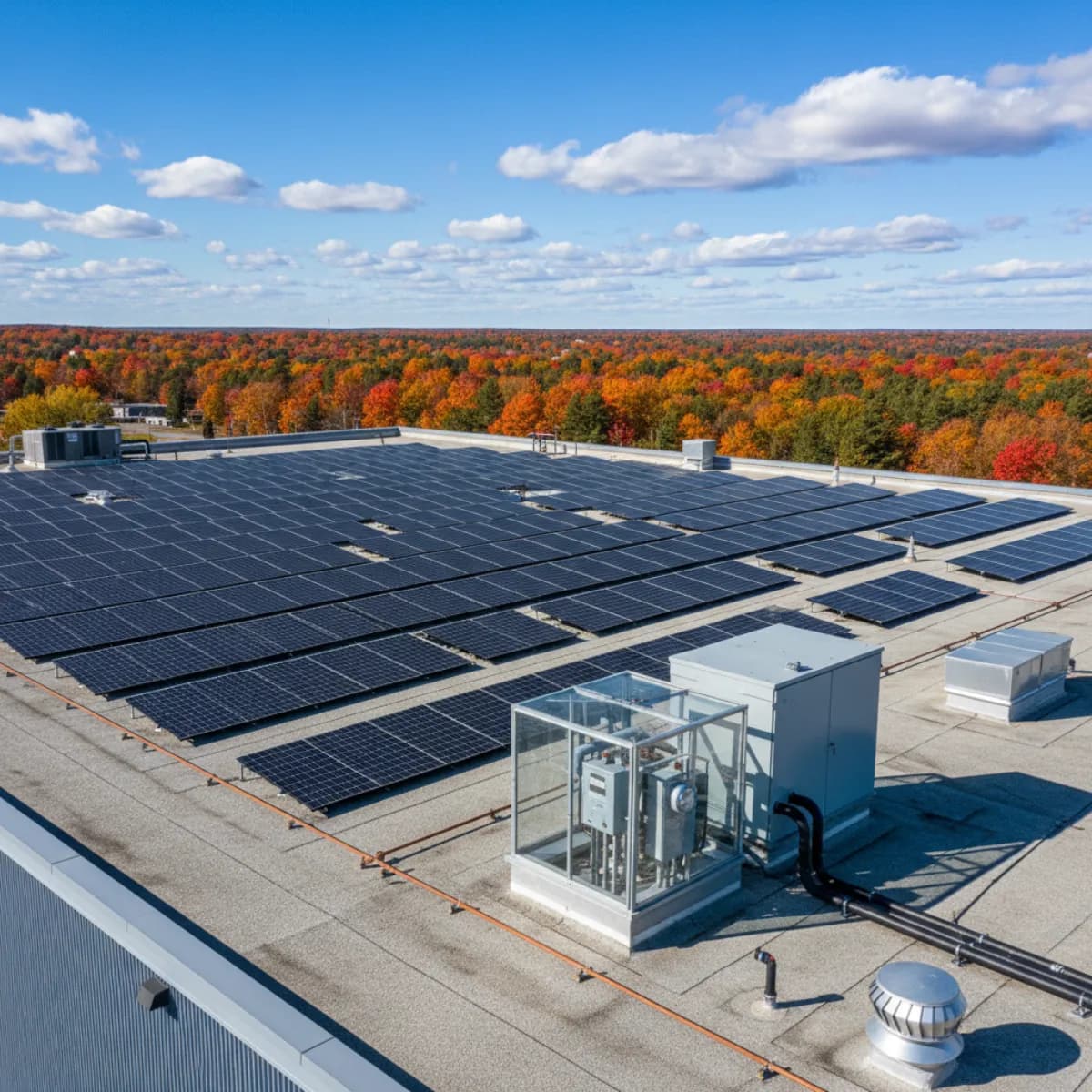
Massachusetts commercial solar earns from SMART payments and the bill offsetyour generation provides — but for a behind-the-meter system these are not additive: the SMART incentive is the compensation rate minus the Value of Energy, so the bill offset is already netted into the gross compensation rate rather than stacked on top. A standalone or community-shared system earns the full SMART rate, with net metering handled separately. The federal Section 48/48E ITC and MACRS depreciation are the one-time, genuinely independent benefits that reduce the effective system cost.
The compensation rate is the same statewide no matter which of the three investor-owned utilities serves you — what differs by utility is the annual capacity allocation. Program Year 2026 opens a single 600 MW AC statewide quantity, split across the three EDCs below. This caps how much new capacity each utility can enroll this year; it does not change the rate. Municipal light plants are excluded from SMART entirely.
Territory
Eastern MA, Greater Boston, Cape Cod
PY2026 Capacity Allocation
294.06 MW AC
Share of 600 MW Block
49%
Customers
~1.5 million
Territory
Central & Western MA, Greater Boston suburbs
PY2026 Capacity Allocation
270.90 MW AC
Share of 600 MW Block
45%
Customers
~1.3 million
Territory
Fitchburg area
PY2026 Capacity Allocation
35.04 MW AC
Share of 600 MW Block
6%
Customers
~27,000
If your business is served by a municipal light plant (e.g., Braintree Electric, Wellesley Municipal Light, Reading Municipal Light, Holyoke Gas & Electric), you are not eligible for SMART payments. Municipal utilities have their own net metering and interconnection rules, which are generally less favorable than SMART. See our municipal light solar guide for details.
SMART 3.0 sets one statewide base compensation rate for each system-size category. The rate steps down as systems get larger, and DOER resets the whole schedule once a year — it does not decline block-by-block within the year the way SMART 1.0/2.0 did. The Program Year 2026 commercial base compensation rates (systems over 25 kW AC) are below; these are gross rates, so a behind-the-meter system nets the Value of Energy out while a standalone system earns the full rate. Adders stack on top.
| System Size Category | PY2026 Base Compensation Rate | What It Means |
|---|---|---|
| >25 – ≤250 kW AC | $0.2807/kWh | Behind-the-meter capacity in this tier is UNCAPPED for PY2026. |
| >250 – ≤500 kW AC | $0.2430/kWh | Standalone >25–≤500 kW share a 10% capacity set-aside. |
| >500 – ≤1,000 kW AC | $0.2317/kWh | Mid-scale ground-mount and canopy projects. |
| >1,000 – ≤5,000 kW AC | $0.1790/kWh | >1 MW without a locational adder must co-locate storage. |
PY2026 statewide base compensation rates (DOER SMART 3.0 Annual Program Year Report, Table 5). Gross rates before the Value-of-Energy offset for behind-the-meter systems. Adders (canopy, dual-use agricultural, storage, etc.) are additional. Systems ≤25 kW instead receive the flat $0.03/kWh incentive ($0.06 low income).
Because rates reset annually, timing matters differently than it did under the old blocks: DOER files draft Program Year 2027 rates by October 1, 2026 and finalizes them by December 1, 2026, with any year-over-year step-down capped at 20% or 1¢. Your rate is fixed at your Statement of Qualification for the full 20-year term, so qualifying under the current program year locks in that year's schedule. PY2026 capacity has generous headroom — systems ≤25 kW and behind-the-meter systems >25–≤250 kW are uncapped, with set-asides reserving capacity for standalone >25–≤500 kW (10%), Low Income Property (10%), and Community Shared (15%).
SMART adders pay additional $/kWh on top of your size-tier base compensation rate. A project may claim at most one location-based adder (canopy, dual-use agricultural, landfill, floating, brownfield, raised racking, or building-mounted) and one off-taker-based adder(community shared, low income property, or public entity), with Brownfield the exception that may combine — plus the stackable Pollinator, Solar-Tracking, and Energy-Storage items. For commercial systems, the canopy, dual-use agricultural, and storage adders are particularly valuable, each adding tens of thousands of dollars per year to project income.
+$0.09/kWh
Agrivoltaics — solar over active farmland. The highest-value PY2026 adder. Requires UMass Clean Energy Extension review.
200 kW system: $21,600/year additional ($432,000 over 20 years)
+$0.08/kWh
Solar mounted on a purpose-built parking canopy or carport that provides covered parking. A top location-based adder.
200 kW system: $19,200/year additional ($384,000 over 20 years)
+$0.07/kWh
Off-taker adder for multi-subscriber community solar. Carries a 15% capacity set-aside for PY2026.
200 kW system: $16,800/year additional ($336,000 over 20 years)
+$0.05/kWh
Off-taker adder for systems serving income-eligible housing or low-income customers. Carries a 10% capacity set-aside.
200 kW system: $12,000/year additional ($240,000 over 20 years)
+$0.04/kWh
Energy Storage Multiplier for a paired battery meeting SMART dispatch rules. Stacks with ConnectedSolutions revenue. The listed rate is the published table figure — DOER settles the project-level value through its Program Year 2026 Energy Storage Adder Calculator workbook.
200 kW system: $9,600/year additional ($192,000 over 20 years)
+$0.03/kWh
Rooftop or facade-mounted systems on an existing building — the most common commercial configuration.
200 kW system: $7,200/year additional ($144,000 over 20 years)
Gross 20-year SMART compensation: $1,923,360. A behind-the-meter canopy nets the Value of Energy out of this gross rate; a standalone or community-shared system earns the full amount. Use the calculator above to net your own Value of Energy.
On the storage line specifically: DOER lists the Energy Storage Multiplier at $0.04/kWh in the Program Year 2026 adder-rate table (mass.gov SMART 3.0 Program Details). Use it as the published rate, not as a project quote — what a specific paired battery actually earns is settled by DOER's Program Year 2026 Energy Storage Adder Calculator workbook, which weighs the battery's power and duration against the solar it is paired with. Run the workbook before putting a storage figure in a pro forma.
Below are three representative commercial solar scenarios in Massachusetts, showing SMART revenue with applicable adders. Each uses 1,200 kWh/kW annual production, which is typical for central/eastern MA with south-facing orientation.
60,000 kWh/year · Behind-the-meter
240,000 kWh/year · Behind-the-meter
600,000 kWh/year · Standalone / community
The figures above are grossSMART compensation (base rate plus adder). For a behind-the-meter system, the Value of Energy — the bill-offset value your own generation captures — is netted out of that gross rate, so you do not add gross SMART on top of full electricity savings; a standalone or community-shared system instead receives the full rate on all generation. Enter your own utility rate and Value of Energy in the calculator above, and layer the one-time federal ITC and MACRS depreciation on top of whichever structure applies.
SMART and net metering are not simply additive. For a behind-the-meter system, the SMART incentive is the compensation rate minus the Value of Energy, so the bill-offset value you capture is netted out of the SMART payment rather than stacked on top of it. The gross compensation rate (base + adders) therefore bundles both the SMART payment and the bill offset. A standalone or community-shared system instead earns the full compensation rate as a SMART payment, with net metering handled separately. The federal ITC is the one truly independent stream.
$67,368/yr
$1,347,360 over 20 years
PY2026 statewide base compensation rate x total kWh generated.
$19,200/yr
$384,000 over 20 years
PY2026 canopy/carport location-based adder, +$0.08/kWh.
$86,568/yr
$1,731,360 over 20 years
Behind-the-meter: this gross figure already bundles the SMART payment and your bill offset (Value of Energy), so do not add full electricity savings again. Standalone / community: the full amount is paid as SMART, with net metering separate. Model your own Value of Energy in the calculator above.
On top of the 20-year SMART stream, the one-time federal Section 48/48E ITC and accelerated MACRS depreciation reduce the effective system cost in the first years. Canopy systems carry a structural premium over rooftop — a 200 kW canopy runs closer to $1.1M than a rooftop's ~$350K — so model the ITC, depreciation, and payback for your actual structure in the carport & canopy ROI calculator.
Your SMART compensation rate is fixed for 20 years, but the Value of Energy netted against it — and the bill offset a standalone system captures through net metering — rises as utility rates climb. At 3-5% annual escalation (MA historical average), that bill-offset value roughly doubles over 20 years. SMART provides a fixed floor, while rising electricity costs lift the ceiling.
The SMART enrollment process for commercial systems involves several steps. Your installer typically manages the SMART application, but understanding the process helps you make informed decisions about timing and project design.
Your installer designs the system and submits an interconnection application to your utility. For commercial systems, this includes a preliminary review and may require utility infrastructure upgrades. Timeline: 2-8 weeks depending on system size and utility territory.
Once interconnection is approved, your installer submits the SMART application to DOER through the program administrator (masmartsolar.com). The application specifies system size, location, and eligible adders. Your program-year compensation rate is fixed when DOER issues your Statement of Qualification.
DOER reviews the application and issues a Statement of Qualification, confirming your SMART rate and contract terms. This is the critical document that locks your rate for 20 years.
Install and commission the solar system. For commercial projects, this typically takes 2-6 months depending on system size, permitting requirements, and structural considerations.
Once the system is operational and passes inspection, SMART payments begin. Payments are made by your utility on a regular billing cycle based on metered generation.
The entire SMART enrollment process for commercial systems typically takes 4-9 months from initial design to payment commencement. Qualifying under the current program year locks in this year's statewide rate schedule before DOER resets rates for Program Year 2027 (draft by Oct 1, 2026; final by Dec 1, 2026). To learn more about the program, see our SMART program overview and SMART adders guide.
Complete guide: ITC stacking, SMART 3.0, financing, and ROI for MA businesses.
Deep dive into every SMART adder: canopy, storage, agricultural, building-mounted, and more.
Carport costs, SMART canopy adder value, EV charging integration, and permitting guide.
Full IRR/NPV calculator combining ITC, MACRS, SMART revenue, and electricity savings.
Get your commercial rate and incentive analysis
We model your bill against current program rates for your utility and usage.
Under SMART 3.0 the base compensation rate is STATEWIDE by system-size category and set annually by DOER — not a per-utility declining block. For Program Year 2026 the commercial (>25 kW AC) base compensation rates are $0.2807/kWh for >25–≤250 kW, $0.2430/kWh for >250–≤500 kW, $0.2317/kWh for >500–≤1,000 kW, and $0.1790/kWh for >1–≤5 MW. These are gross rates: a behind-the-meter system nets the Value of Energy out, while a standalone system earns the full rate. Adders stack on top, and your rate is fixed for the 20-year term at your Statement of Qualification.
DOER resets the statewide rates each program year. Get a custom SMART revenue projection for your commercial property — including applicable adders and 20-year cash flow analysis.