Loading NuWatt Energy...

We use your location to provide localized solar offers and incentives.
We serve MA, NH, CT, RI, ME, VT, NJ, PA, and TX
Loading NuWatt Energy...
Use the free estimator for a preliminary layout, or share your preferred response method with the commercial team. Final feasibility still requires site, utility, and engineering review.
From initial site assessment to permission to operate (PTO), a CT commercial solar project takes 6-18 months depending on system size, utility territory, and permitting complexity. This guide walks you through every phase with CT-specific timelines for Eversource CT and United Illuminating territories.
Total Timeline
6-18 Mo
Permitting
3-8 Wks
Construction
4-12 Wks
PTO Process
2-6 Wks
A CT commercial solar project takes 6-18 months from site assessment to permission to operate (PTO). The seven phases include: site assessment (2-4 weeks), engineering and design (3-6 weeks), permitting with CGS 16a-35k as-of-right protections (3-8 weeks), utility interconnection with Eversource CT or UI (4-12 weeks), equipment procurement (4-12 weeks), construction (4-12 weeks), and inspection/PTO (2-6 weeks). The CT Siting Council adds 3-9 months for systems exceeding 1 MW. Common delays include interconnection queue backlogs and transformer upgrades.
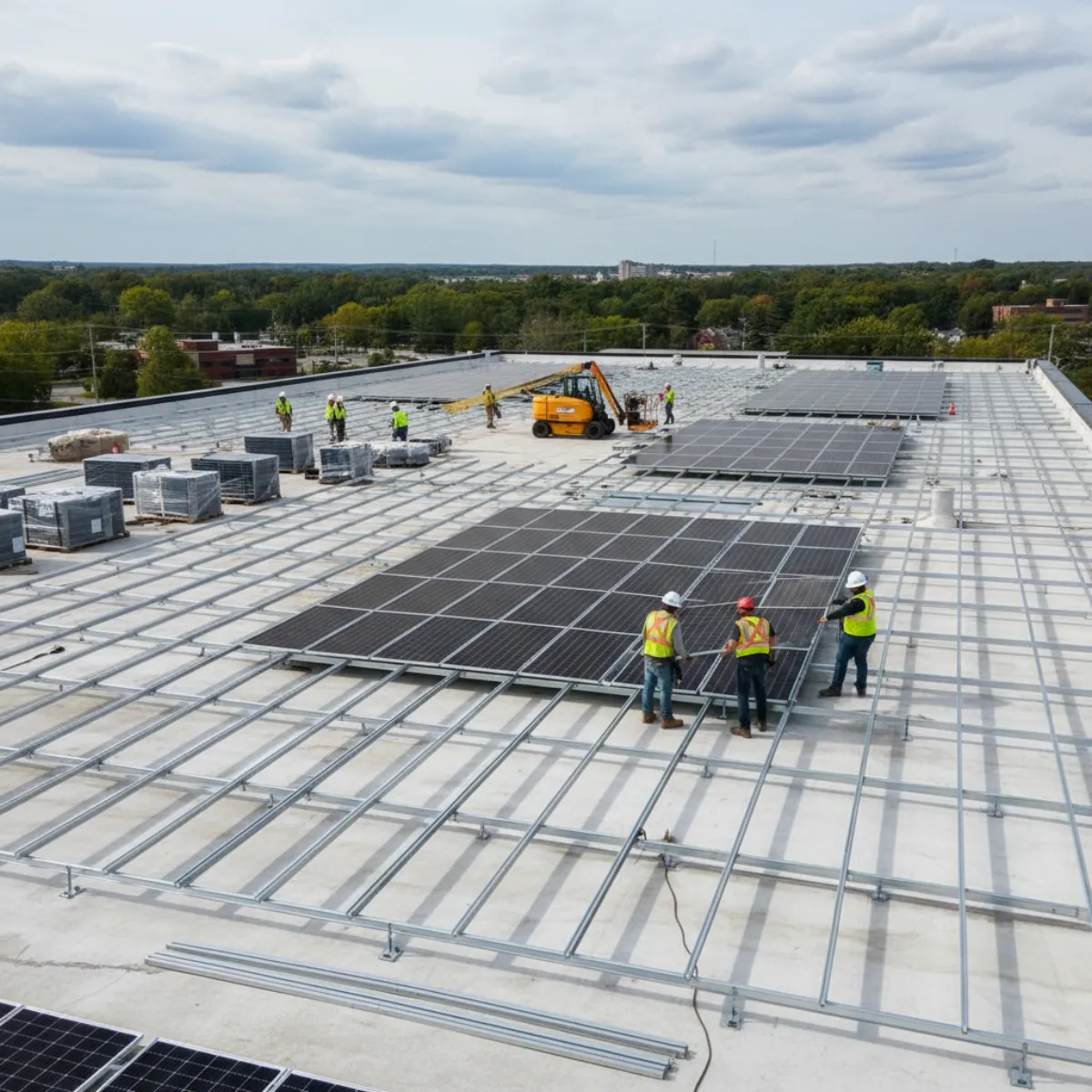
Connecticut commercial solar projects follow a structured seven-phase process from initial feasibility through final permission to operate. The total duration ranges from 6 months for straightforward small rooftop systems to 18 months or more for large ground-mount installations requiring CT Siting Council review.
Several CT-specific factors affect your timeline. Connecticut General Statutes Section 16a-35k provides as-of-right solar siting protections, meaning municipalities cannot unreasonably restrict solar installations through zoning alone. However, local permitting requirements still vary significantly between CT's 169 municipalities. Utility interconnection timelines differ between Eversource CT (serving approximately 75% of commercial customers) and United Illuminating (serving the greater Bridgeport and New Haven areas).
For systems exceeding 1 MW, the Connecticut Siting Council has exclusive jurisdiction under CGS Section 16-50i, which adds a formal petition and review process. The current regulatory environment under PURA (Public Utilities Regulatory Authority) and CT DEEP (Department of Energy and Environmental Protection) supports commercial solar development, but navigating the process efficiently requires understanding each phase and its CT-specific requirements.
The Section 48/48E ITC offered a longer placed-in-service pathway to projects that began construction on or before July 4, 2026; new starts now generally must be placed in service by December 31, 2027. With 100% MACRS bonus depreciation available in the year a system is placed in service, timeline management is critical for maximizing your commercial solar investment.
Each phase includes CT-specific considerations for Eversource CT and United Illuminating service territories, permitting requirements, and regulatory compliance.
CT-Specific Note: CT municipalities vary widely in permitting requirements. Some towns like Hartford and Stamford have streamlined online portals, while rural towns may still require in-person submissions. Identify your town's process early.
CT-Specific Note: CT follows the 2021 IECC with CT-specific amendments. Rapid shutdown requirements per NEC 2020 apply to all new commercial solar installations. Systems over 25 kW require PE-stamped drawings.
CT-Specific Note: Connecticut General Statutes Section 16a-35k establishes that solar energy systems cannot be unreasonably restricted by local zoning. However, municipalities can still impose reasonable setback, height, and screening requirements. Some towns have adopted solar-specific zoning overlays.
CT-Specific Note: Eversource CT and United Illuminating have different interconnection timelines and processes. Eversource serves ~75% of CT commercial customers. UI territory (greater Bridgeport/New Haven area) typically has faster interconnection timelines for smaller systems. Impact studies for systems >1 MW can add 2-4 months.
CT-Specific Note: For projects seeking the domestic content ITC bonus (+10%), panels must be manufactured in the US (Silfab, Q.CELLS Georgia, REC). Supply chains tightened in 2025-2026 due to FEOC requirements. Order early to avoid delays.
CT-Specific Note: CT prevailing wage requirements apply to state-funded projects and projects receiving certain public incentives. Verify whether your project triggers prevailing wage or apprenticeship requirements under Connecticut labor law. Construction during winter months (December-February) may face weather delays.
CT-Specific Note: PTO from Eversource CT typically takes 2-4 weeks after passing inspection. UI may be slightly faster. Do not energize the system until PTO is received — operating without PTO violates utility interconnection agreements and CT regulations.
Your utility territory significantly impacts interconnection timeline. Here is a comparison of typical processing times for commercial solar applications.
| System Size | Review Level | Eversource CT | United Illuminating |
|---|---|---|---|
| < 25 kW | Level 1 (Fast Track) | 2-4 weeks | 2-3 weeks |
| 25 kW - 300 kW | Level 2 (Supplemental) | 4-8 weeks | 3-6 weeks |
| 300 kW - 2 MW | Level 2/3 | 6-12 weeks | 4-8 weeks |
| > 1 MW | Impact Study Required | 8-16 weeks | 6-12 weeks |
| > 2 MW | Full System Impact Study | 12-24 weeks | 10-20 weeks |
Eversource serves most of Connecticut including Hartford, New London, Middletown, and Norwich areas. Their interconnection queue has been congested in southern CT corridors. Pre-application inquiries are strongly recommended for systems over 200 kW. Net metering is available at retail rate for systems up to 2 MW under PURA-approved tariffs.
UI serves the greater Bridgeport and New Haven areas, covering approximately 25% of CT commercial customers. UI's smaller service territory often means faster interconnection processing. Their online portal provides real-time application status tracking. Commercial rates average $0.221/kWh, making solar ROI attractive.
The Connecticut Siting Council has exclusive jurisdiction over electric generating facilities with a capacity of 1 MW or more, as established under Connecticut General Statutes Section 16-50i. This preempts local zoning authority, meaning the Siting Council — not the municipality — has the final say on project approval.
The petition process typically involves filing a formal petition for a declaratory ruling, publishing public notice in local newspapers, hosting informational open houses, conducting environmental impact assessments, and attending formal public hearings. The Council evaluates projects based on environmental compatibility, visual impact, agricultural land preservation, and public benefit.
For CT commercial solar developers, this means projects at 999 kW avoid Siting Council jurisdiction entirely, while projects at 1.0 MW or above trigger the full review process. Many developers strategically size systems just below the 1 MW threshold to avoid the additional 3-9 months and $50,000-$150,000 in legal and environmental consulting fees that the Siting Council process requires.
Strategic Sizing Consideration
A 999 kW system avoids CT Siting Council review and can complete in 6-12 months. A 1.0 MW system triggers formal review adding 3-9 months and significant legal costs. The additional 1 kW produces approximately $350/year in extra electricity — far less than the cost and delay of Siting Council review. For most CT commercial projects, staying just below 1 MW is the optimal strategy unless the additional capacity is substantial (e.g., 2+ MW).
Understanding potential bottlenecks helps you plan proactively and keep your CT commercial solar project on schedule.
Eversource CT has experienced interconnection queue congestion, particularly in southern CT where distribution circuits are near capacity. Systems >500 kW in constrained areas may face supplemental review or impact studies.
Mitigation: Submit interconnection application as early as possible — even before final engineering is complete. A pre-application inquiry can identify grid constraints before committing to a site.
If the local distribution transformer cannot support the solar system export, the utility will require a transformer upgrade at the developer's expense. Costs range from $15,000-$75,000+.
Mitigation: During site assessment, evaluate the existing transformer rating. Size the system to stay within transformer limits or factor upgrade costs into the project budget.
Systems exceeding 1 MW fall under CT Siting Council jurisdiction (Connecticut General Statutes Section 16-50i). This requires a formal petition, public hearings, and environmental review.
Mitigation: Engage environmental and legal consultants early. Pre-application conferences with the Siting Council can streamline the process. Consider phasing the project to stay below 1 MW thresholds.
Despite CGS 16a-35k as-of-right provisions, some CT municipalities impose additional requirements — wetland reviews, site plan reviews, or planning and zoning commission hearings.
Mitigation: Research your specific municipality's solar permitting process before committing to a timeline. Hartford, New Haven, and Stamford have well-established processes. Smaller towns may require more lead time.
FEOC-compliant domestic panels (Silfab, Q.CELLS US, REC) have limited production capacity. Inverter lead times have also extended due to global semiconductor constraints.
Mitigation: Lock in equipment orders and deposits early. Consider alternative panel brands that meet domestic content requirements. Maintain relationships with multiple distributors.
Start site assessment and engineering to capture all 2026 incentives
Projects that began construction (or paid the 5% safe harbor deposit) by this date locked in the longer Section 48/48E pathway
Place system in service to claim 100% MACRS bonus depreciation (permanent under OBBBA)
Net metering at retail rate for systems up to 2 MW via Eversource CT or UI. CT sales tax 6.35% and property tax 100% exemptions remain in effect
Realistic timelines for three common CT commercial solar project sizes, assuming no major grid upgrade requirements.
50 kW Rooftop
4-7 months
Fastest path. Level 1 interconnection. No Siting Council.
250 kW Warehouse
7-12 months
Level 2 interconnection. May require supplemental review.
999 kW Ground-Mount
10-18 months
Sized below 1 MW to avoid CT Siting Council. Impact study likely.
If using CT Green Bank C-PACE financing, the application process runs in parallel with permitting and design phases. C-PACE adds approximately 8-12 weeks from initial application to funding approval, but this time overlaps with other project activities rather than extending the total timeline significantly.
Pre-screening with CT Green Bank
During site assessment
Capital provider selection and term sheet
During engineering/design
Legal documentation and closing
During permitting
Funding disbursement
Before construction start
Complete guide to ITC, MACRS, and C-PACE for CT businesses
Calculate your project internal rate of return
100% financing via CT Green Bank C-PACE program
Properly size your commercial solar from energy audit data
A typical CT commercial solar project takes 6-18 months from initial site assessment to permission to operate (PTO). Small systems (<100 kW) on simple rooftops can be completed in 6-9 months. Mid-size systems (100-500 kW) typically take 9-12 months. Large systems (>500 kW) or those requiring CT Siting Council review can take 12-18 months. The biggest variables are utility interconnection timelines and any required grid upgrades.
NuWatt manages permitting, utility interconnection, and C-PACE applications for Connecticut commercial properties. Get a realistic project timeline for your specific property.