Loading NuWatt Energy...

We use your location to provide localized solar offers and incentives.
We serve MA, NH, CT, RI, ME, VT, NJ, PA, and TX
Loading NuWatt Energy...
NuWatt designs, installs, and manages solar, battery, heat pump, and EV charger systems across 9 states. One company, one warranty, one point of contact.
Get a Free QuoteProperly sizing commercial solar starts with understanding your energy consumption. This guide covers how to read Eversource CT and United Illuminating commercial bills, analyze load profiles, leverage Energize CTfree energy audits, and calculate the optimal system size using CT's 1,175 kWh/kW/year production factor.
CT Solar Production
1,175 kWh/kW/yr
Avg Commercial Rate
$0.221/kWh
Rooftop Density
7-10 W/sq ft
Optimal Offset
80-120%
Size CT commercial solar by: (1) Collect 12 months of Eversource CT or UI utility bills, (2) Calculate annual kWh consumption and peak demand, (3) Complete Energize CT efficiency improvements first to reduce baseline load, (4) Divide annual kWh by 1,175 (CT solar production factor) to get system size in kW, (5) Verify available roof area (7-10 W/sq ft) or ground area (4-6 W/sq ft), (6) Target 80-120% consumption offset. A building using 200,000 kWh/year needs approximately 170 kW of solar.
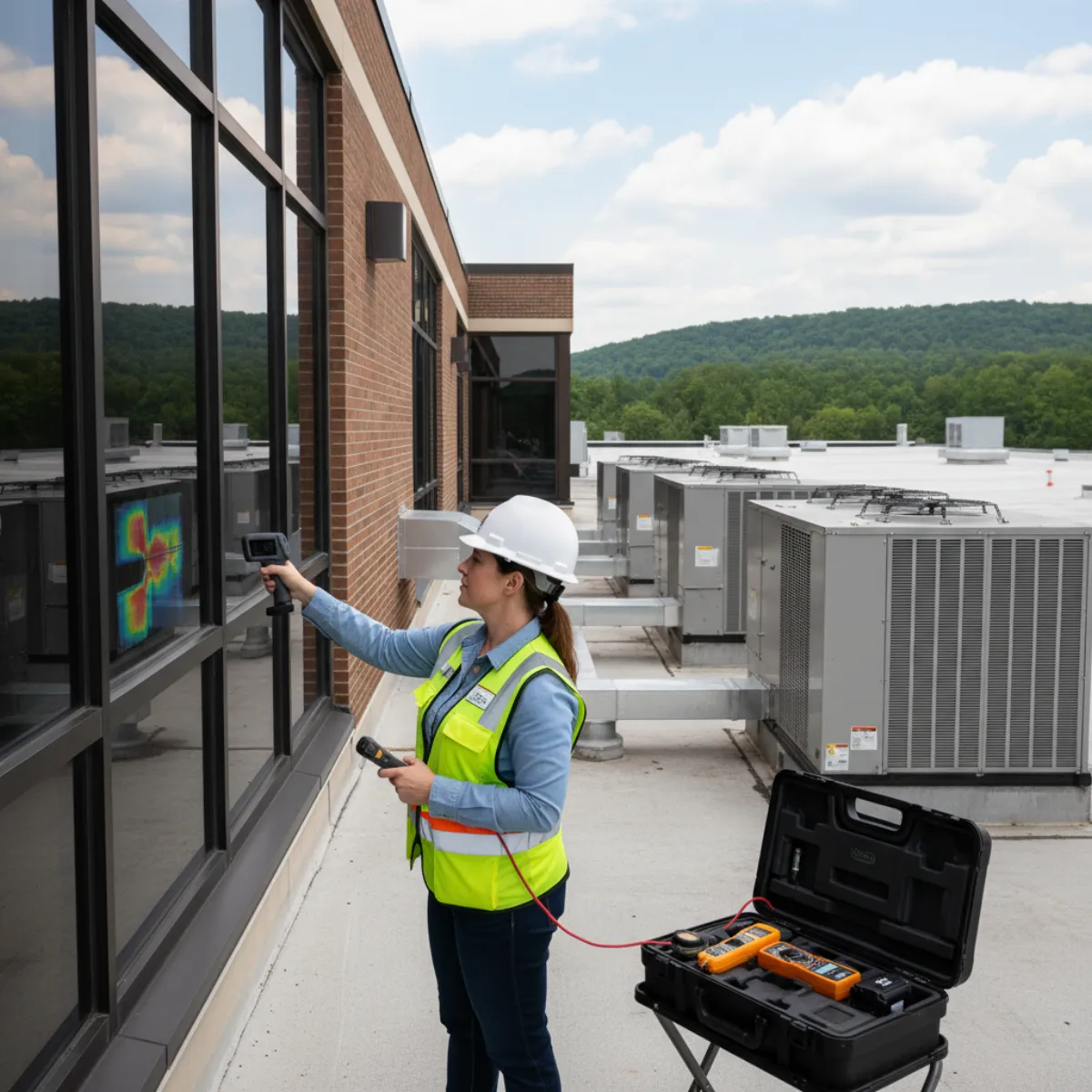
The most common commercial solar sizing mistake is designing a system based on current electricity consumption without first addressing energy waste. A comprehensive energy audit identifies opportunities to reduce your baseline load by 15-25% through lighting upgrades, HVAC optimization, building envelope improvements, and controls automation.
In Connecticut, Energize CT provides funded commercial energy audits through two primary programs. The Small Business Energy Advantage (SBEA) program serves businesses with peak demand under 200 kW and offers free energy audits, 0% interest financing for efficiency improvements, and direct-install lighting upgrades. The Commercial & Industrial (C&I) program serves larger facilities with custom engineering studies, prescriptive rebates, and performance-based incentives.
By reducing your load first, you need a smaller solar system to achieve the same percentage offset. A building consuming 300,000 kWh/year that reduces to 240,000 kWh/year through efficiency measures needs a 204 kW solar system instead of 255 kW — saving approximately $85,000-$95,000 in system costs at CT mid-size commercial pricing of $1.60-$1.90/W.
Both Eversource CT and United Illuminating administer Energize CT programs in their service territories. The audit process typically takes 2-4 weeks, and efficiency improvements can be completed in 4-8 weeks — fitting neatly into the early phases of your commercial solar project timeline.
Energize CT audits typically identify 15-25% savings from lighting, HVAC, and controls upgrades. Smaller solar system = lower cost.
Design solar for post-efficiency consumption. A 170 kW system costs $50,000-$75,000 less than a 215 kW system.
Combined efficiency + solar delivers better IRR than solar alone. Stacked with 30% ITC and MACRS depreciation.
Eversource CT and United Illuminating bills contain the essential data for solar sizing. Here are the key line items to extract from your 12 months of billing history.
Cost of electricity generation — this is what solar directly offsets. In CT, supply charges average $0.10-$0.14/kWh for commercial accounts.
Delivery cost from utility infrastructure — partially offset by net metering credits. Eversource CT and UI structure these differently.
Based on your peak 15-minute demand in the billing period. Ranges from $8-$18/kW/month in CT. Solar alone does not reduce demand charges — battery storage is needed.
Total electricity consumed in the billing period. Track all 12 months to account for seasonal variation (HVAC loads drive summer peaks).
Highest 15-minute demand reading. Important for demand charge analysis and battery storage ROI. Eversource uses on-peak/off-peak demand in Rate 30.
Eversource: Rate 30 (small commercial), Rate 35 (medium), Rate 37 (large). UI: Rate GST (small), Rate GS-Secondary (medium), Rate GS-Primary (large).
Solar sizing requires a full 12 months of consumption data to capture seasonal variation. Connecticut commercial buildings typically see summer peaks from air conditioning loads (June-September) and winter peaks from electric heating or increased lighting hours (December-February). The shoulder months (April-May, October-November) often represent baseline load without significant HVAC influence.
From your 12 months of bills, calculate: total annual kWh consumption, average monthly kWh, peak monthly kWh, minimum monthly kWh, average peak demand (kW), and maximum peak demand (kW). The ratio of peak to minimum monthly consumption reveals your seasonal load variability — higher ratios indicate HVAC-dominated buildings where solar production conveniently peaks when consumption peaks (summer cooling).
For businesses that have undergone operational changes in the past 12 months (expansion, tenant changes, equipment additions), adjust historical data to reflect current expected consumption. If you are planning to add electric vehicle charging stations, heat pumps, or other electric loads, factor these into your projected annual consumption before sizing solar.
Different building types have different energy consumption patterns, which affects how well solar production aligns with your demand.
Peak Hours
8 AM - 6 PM weekdays
Avg Usage
12-20 kWh/sq ft/year
Solar Match
Excellent
Peak demand aligns well with solar production hours. HVAC cooling loads in summer coincide with peak solar output. Minimal weekend usage means excess solar exports to grid via net metering.
Size at 90-100% offset. Office buildings are ideal candidates for rooftop solar.
Peak Hours
6 AM - 4 PM weekdays
Avg Usage
6-12 kWh/sq ft/year
Solar Match
Very Good
Large flat roofs provide excellent solar acreage. Lower energy density means a relatively small system can offset a high percentage. Lighting upgrades via Energize CT often reduce baseline load before sizing solar.
Size at 100-120% offset. Large roof area usually allows full offset plus export.
Peak Hours
10 AM - 9 PM daily
Avg Usage
20-40 kWh/sq ft/year
Solar Match
Good
High energy intensity from refrigeration, cooking, and lighting. Evening hours extend past solar production. Battery storage can shift solar to cover evening loads. Weekend operation aligns with solar availability.
Size at 70-90% offset due to evening consumption exceeding solar production hours.
Peak Hours
Varies by shift schedule
Avg Usage
15-50 kWh/sq ft/year
Solar Match
Moderate to Good
High demand charges from motors and heavy equipment. Solar reduces energy charges but demand charges require battery storage for significant reduction. Multi-shift operations may have 24-hour loads.
Size based on daytime load profile. Add battery for demand charge management if applicable.
Connecticut commercial solar sizing uses a straightforward methodology once you have your 12-month usage data and have completed efficiency improvements via Energize CT. The key variable is the CT solar production factor of 1,175 kWh per installed kW per year, derived from NREL PVWatts modeling for Connecticut latitudes.
The target offset percentage depends on your goals and constraints. Most CT commercial projects target 80-120% offset. Systems up to 2 MW can net meter at retail rate under PURA-approved tariffs, meaning excess production earns full credit. Oversizing slightly (110-120%) provides a hedge against future consumption growth and panel degradation (approximately 0.5%/year).
| Step | Formula | Example |
|---|---|---|
| Annual kWh consumption from utility bills | Sum 12 months of kWh | 200,000 kWh/year |
| Target offset percentage | 80-120% (100% typical) | 100% = 200,000 kWh |
| CT solar production factor | 1,175 kWh/kW/year (PVWatts) | 1,175 kWh/kW |
| Required system size (kW) | Target kWh / 1,175 | 200,000 / 1,175 = 170 kW |
| Roof area needed (rooftop) | kW / 7-10 W per sq ft | 170,000 W / 8 = 21,250 sq ft |
| Ground area needed (ground-mount) | kW / 4-6 W per sq ft | 170,000 W / 5 = 34,000 sq ft |
| Estimated annual savings | Target kWh x blended rate | 200,000 x $0.27 = $54,000/year |
| Estimated system cost | kW x $/W for tier | 170 kW x $1,750 = $297,500 |
CT-Specific Note: The 1,175 kWh/kW/year production factor assumes south-facing orientation at optimal tilt (25-35 degrees) with minimal shading. East/west orientations reduce production by 10-15%. Flat commercial rooftops using ballasted racking at 10-degree tilt produce approximately 1,050-1,100 kWh/kW/year. Adjust your sizing calculation accordingly based on your specific site conditions.
Available area is often the primary constraint on commercial solar system size. Rooftop systems achieve higher power density (7-10 W/sq ft) because panels can be closely spaced on flat or low-slope commercial roofs. Ground-mount systems require more area (4-6 W/sq ft) due to inter-row spacing needed for optimal tilt angle without self-shading.
Connecticut fire codes require minimum 3-foot setbacks from roof edges and clear access pathways for firefighter access. HVAC equipment, skylights, plumbing vents, and structural limitations further reduce usable roof area. A professional site assessment using drone imagery or satellite analysis identifies exact usable area. For ground-mount systems on CT properties, consider wetland setbacks, easements, and local zoning setback requirements that may reduce buildable area.
For businesses with peak demand under 200 kW — covers most small to mid-size commercial properties in CT.
For larger facilities with demand over 200 kW — comprehensive engineering studies and custom measure analysis.
NREL's PVWatts Calculator is the industry-standard free tool for estimating solar production at any Connecticut location. For commercial projects, PVWatts provides hourly production estimates that can be compared against your hourly load profile (if available from interval meter data) for precise self-consumption vs. export analysis.
Key PVWatts inputs for CT commercial solar: System size in kW DC, module type (standard crystalline silicon), array type (fixed roof-mount at 10 degrees for flat roofs, or fixed ground-mount at 25-35 degrees for optimal tilt), azimuth (180 degrees for south-facing, adjust for actual roof orientation), and system losses (default 14% accounts for soiling, wiring losses, inverter efficiency, and degradation).
Connecticut PVWatts results typically range from 1,150-1,200 kWh/kW/year for optimally oriented systems. Hartford averages 1,170 kWh/kW, Bridgeport averages 1,185 kWh/kW, and coastal areas slightly higher due to reflected light from Long Island Sound. We use a conservative 1,175 kWh/kW statewide average for commercial solar sizing.
Complete ITC, MACRS, and incentive guide
Calculate internal rate of return for your project
Analyze battery storage ROI for demand charge reduction
Compare Eversource vs UI rate savings
CT commercial electric bills from Eversource and United Illuminating show several key data points for solar sizing: monthly kWh consumption (track all 12 months), peak demand in kW (highest 15-minute interval), supply charges (what solar offsets directly), distribution charges (partially offset by net metering), and demand charges (requires battery storage to reduce). Eversource Rate 30/35/37 and UI Rate GST/GS-Secondary bills have different formats but contain the same essential data. Request 12 months of billing history or access your online account portal for complete data.
NuWatt analyzes your Eversource CT or UI bills, coordinates Energize CT audits, and designs optimally sized solar for your commercial property. No cost for the initial assessment.