Loading NuWatt Energy...

We use your location to provide localized solar offers and incentives.
We serve MA, NH, CT, RI, ME, VT, NJ, PA, and TX
Loading NuWatt Energy...
NuWatt designs, installs, and manages solar, battery, heat pump, and EV charger systems across 9 states. One company, one warranty, one point of contact.
Get a Free QuoteQuick Answer
A prepaid PPA lets a financing company own your solar system, claim the Section 48E ITC (30%), and pass those savings to you as a lower rate. You did not lose the tax credit — it just moved to a different owner. Your prepaid price is typically 25-35% less than a cash purchase, and you can buy out the system after 5-7 years for a fraction of the original cost.
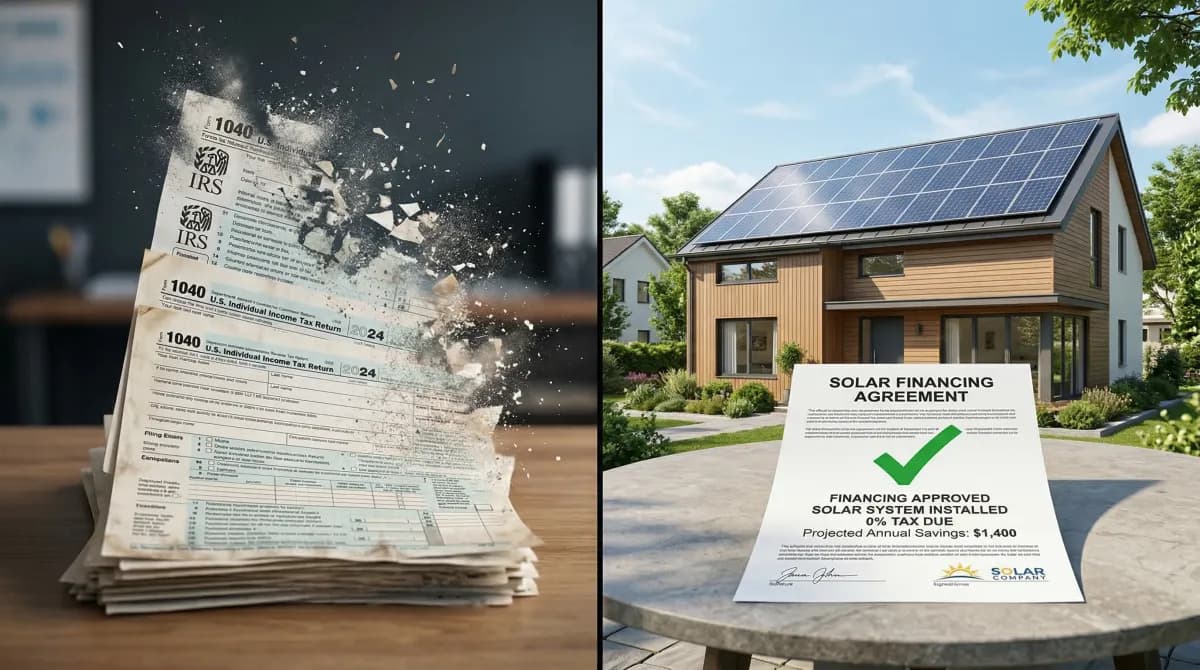
Section 25D expired December 31, 2025. Homeowners get $0 in federal tax credits for cash or loan purchases. But Section 48E is still alive — and a prepaid PPA lets a financing company claim the 30% ITC and pass the savings directly to you.
The residential solar tax credit expired December 31, 2025, when the OBBBA (signed July 4, 2025) repealed it. If you buy a solar system with cash or a loan in 2026, you receive $0 in federal tax credits.
The commercial ITC is available for third-party system owners. The begin-construction safe harbor closed July 4, 2026, and new starts must be placed in service by December 31, 2027. Financing companies that own residential solar systems qualify. The credit is 30% base, plus a 10% domestic content bonus with FEOC-compliant equipment.
The bottom line:The 30% solar discount did not disappear — it just moved from your personal tax return to a business entity's tax return. A prepaid PPA or lease structure is the mechanism that routes those savings back to you. This is not a loophole. It is exactly how Section 48/48E was designed to work.
A prepaid PPA combines the simplicity of a cash purchase with the tax advantages of third-party ownership. Here is the process from start to finish.
The third-party owner (TPO) purchases the panels, inverters, and racking. They contract with a local installer (like NuWatt) to design and build the system on your roof. You sign a PPA or lease agreement.
Because the financing company owns the system, they qualify for the commercial ITC under Section 48/48E. If the panels are FEOC-compliant (manufactured in the US), they also claim the 10% domestic content bonus. That is up to 40% off in tax credits.
The tax savings flow back to you as a reduced price. Instead of paying full retail ($22,000-$28,000 for a 10 kW system), your prepaid amount is $15,000-$20,000. Or you pay a fixed per-kWh rate well below your utility rate.
Your solar panels generate electricity just like any owned system. You consume what you need, and any surplus flows to the grid via net metering, earning credits on your utility bill.
Most prepaid PPA contracts include a buyout option after the initial term. By year 5-7, the fair market value of a depreciated solar system is often a fraction of the original cost — sometimes as low as $1,000-$3,000 for a 10 kW system.
How every major solar financing option compares in 2026 — now that the residential ITC is gone.
| Feature | Cash | Solar Loan | Standard PPA | Prepaid PPA |
|---|---|---|---|---|
| Upfront cost | $22,000-$28,000 | $0 | $0 | $15,000-$20,000 |
| Federal credit | $0 (25D expired) | $0 (25D expired) | Company claims 48E | Company claims 48E |
| Monthly payment | $0 | $195-$260/mo | $0.11-$0.15/kWh | $0 or very low |
| Ownership | Day 1 | Day 1 | Year 5-7 buyout | Year 5-7 buyout |
| 25-year savings | Highest | Moderate | Lowest | High |
| Best for | Max ROI, long hold | Own + spread payments | $0 down priority | Max savings, no ownership risk |
Not all prepaid PPAs are created equal. The panels your system uses directly affect how much the financing company can claim — and how much savings pass through to you.
30% base + 10% domestic content bonus
No domestic content bonus
FEOC Timing: Safe Harbor Closed July 4, 2026
Projects that began construction on or before July 4, 2026 with FEOC-compliant panels locked in the 10% domestic content bonus timing. FEOC component-sourcing thresholds tighten for later construction-start years. This tracks the same begin-construction rules as the Section 48E ITC itself.
Propel is NuWatt's implementation of the prepaid PPA / third-party ownership model described above. Here is how it maps to the structure.
The third-party owner that claims the ITC
FEOC-compliant, US-manufactured, qualifies for domestic content bonus
Additional states planned for 2026-2027
Purchase at fair market value — typically a fraction of original cost
Propel is one option among several. Cash purchases and solar loans remain available for homeowners who prefer immediate ownership, even without the federal credit. See our Propel vs Solar Loan comparison for a side-by-side analysis.
A prepaid PPA is not for everyone. It works best for specific financial situations and goals. Here are four ideal profiles.
You had the money for a cash purchase, but the math changed when 25D expired. A prepaid PPA lets you capture most of that savings through the commercial ITC while paying significantly less than full retail.
In Texas, New Hampshire, and other states without strong production-based incentives, the federal tax credit was the primary driver of solar economics. A prepaid PPA brings that back through a different channel.
You plan to own the system eventually but want the tax credit savings embedded in your price now. A prepaid PPA lets you access the ITC through the financing company, then buy out the system for pennies on the dollar in year 5-7.
You qualify for cash or premium loan rates, but neither option includes any federal credit in 2026. A prepaid PPA is the only residential path to a federally-subsidized solar price right now.
Section 48/48E had a “begin construction” safe harbor on July 4, 2026. That window has closed, but the commercial ITC did not go away: new starts still qualify for the 30% credit and generally must be placed in service by December 31, 2027.
A binding agreement with the installer and financing company, with specifics on equipment, price, and timeline.
Panels, inverters, and racking ordered from the manufacturer or distributor. This creates a paper trail for the IRS.
Physical work started — permitting, interconnection applications, or roof preparation. This demonstrates project commencement.
Practical timeline: Solar design, permitting, and equipment procurement typically take 4-8 weeks. If you want to qualify for the 48E ITC through a prepaid PPA, you need to be signing agreements by late April to mid-May 2026 at the latest.
A prepaid PPA (Power Purchase Agreement) is a solar financing structure where you pay a lump sum upfront to a third-party system owner. They own and maintain the panels on your roof, claim the federal tax credits, and pass those savings to you as a lower total price. After 5-7 years, you can typically purchase the system at a steep discount.
With a cash purchase in 2026, you pay full retail price and receive $0 in federal tax credits (Section 25D expired December 31, 2025). With a prepaid PPA, a financing company owns the system, claims the 30% Section 48E commercial ITC, and passes those savings to you. Your prepaid amount is typically 25-35% less than a cash purchase price.
Not directly. The residential solar tax credit (Section 25D) expired December 31, 2025. However, the commercial ITC (Section 48/48E) is still available for third-party system owners; the begin-construction safe harbor closed July 4, 2026, and new starts must be placed in service by December 31, 2027. Through a prepaid PPA or lease structure, the financing company claims the credit and passes the savings to you as a lower rate or price.
Section 25D was the residential solar ITC — homeowners claimed 30% of their system cost on their personal tax return. It expired December 31, 2025. Section 48/48E is the commercial ITC — businesses and financing companies claim 30% on systems they own. It is still available; the begin-construction safe harbor closed July 4, 2026, and new starts must be placed in service by December 31, 2027.
FEOC stands for Foreign Entity of Concern. Under the IRA, solar panels and components must NOT be manufactured by a FEOC (primarily Chinese-owned entities) to qualify for the 10% domestic content bonus. FEOC-compliant panels like Silfab 440W (manufactured in the US) allow the financing company to claim 40% total ITC (30% base + 10% domestic content), resulting in a lower prepaid price for you.
For a typical 10 kW residential system, a prepaid PPA costs approximately $15,000-$20,000 — compared to $22,000-$28,000 for a cash purchase. The exact amount depends on your state, system size, panel tier (FEOC-compliant panels unlock the domestic content bonus), and the specific financing company.
Most prepaid PPA contracts include a buyout option after 5-7 years. At that point, the system has been depreciated on the financing company's books and the fair market value is typically very low — often $1,000-$3,000 for a 10 kW system. Some structures allow earlier buyouts with different pricing.
Prepaid PPAs and TPO (third-party ownership) solar structures are legal in most states, but availability depends on financing companies operating in your area. NuWatt's Propel program — which uses this structure — is currently available in Maine and Texas. Check with your local installer for TPO options in other states.
Prepaid PPAs are generally transferable to the new homeowner at no cost. Since the payments are already made, the new owner inherits free solar electricity for the remaining contract term. This can increase your home's resale value. The buyout option also transfers to the new owner.
Section 48/48E had a "begin construction" safe harbor on July 4, 2026 — meeting it (a signed contract, equipment ordered, and site preparation started, or 5% of costs incurred) locked in the longer timing pathway. That window has closed, but the credit did not disappear: new starts still qualify for the 30% credit and generally must be placed in service by December 31, 2027.
The Section 48E ITC is still available; the begin-construction safe harbor closed July 4, 2026, and new starts place in service by December 31, 2027. Find out if a prepaid PPA is the right fit for your home.