Loading NuWatt Energy...

We use your location to provide localized solar offers and incentives.
We serve MA, NH, CT, RI, ME, VT, NJ, PA, and TX
Loading NuWatt Energy...
NuWatt designs, installs, and manages solar, battery, heat pump, and EV charger systems across 9 states. One company, one warranty, one point of contact.
Get a Free QuoteCedar shingle and shake roofs are iconic in Massachusetts -- from Cape Cod cottages to North Shore estates. But can you install solar panels on them? Yes, with the right installer and approach. This is your complete guide to costs, methods, fire codes, and historic district requirements.
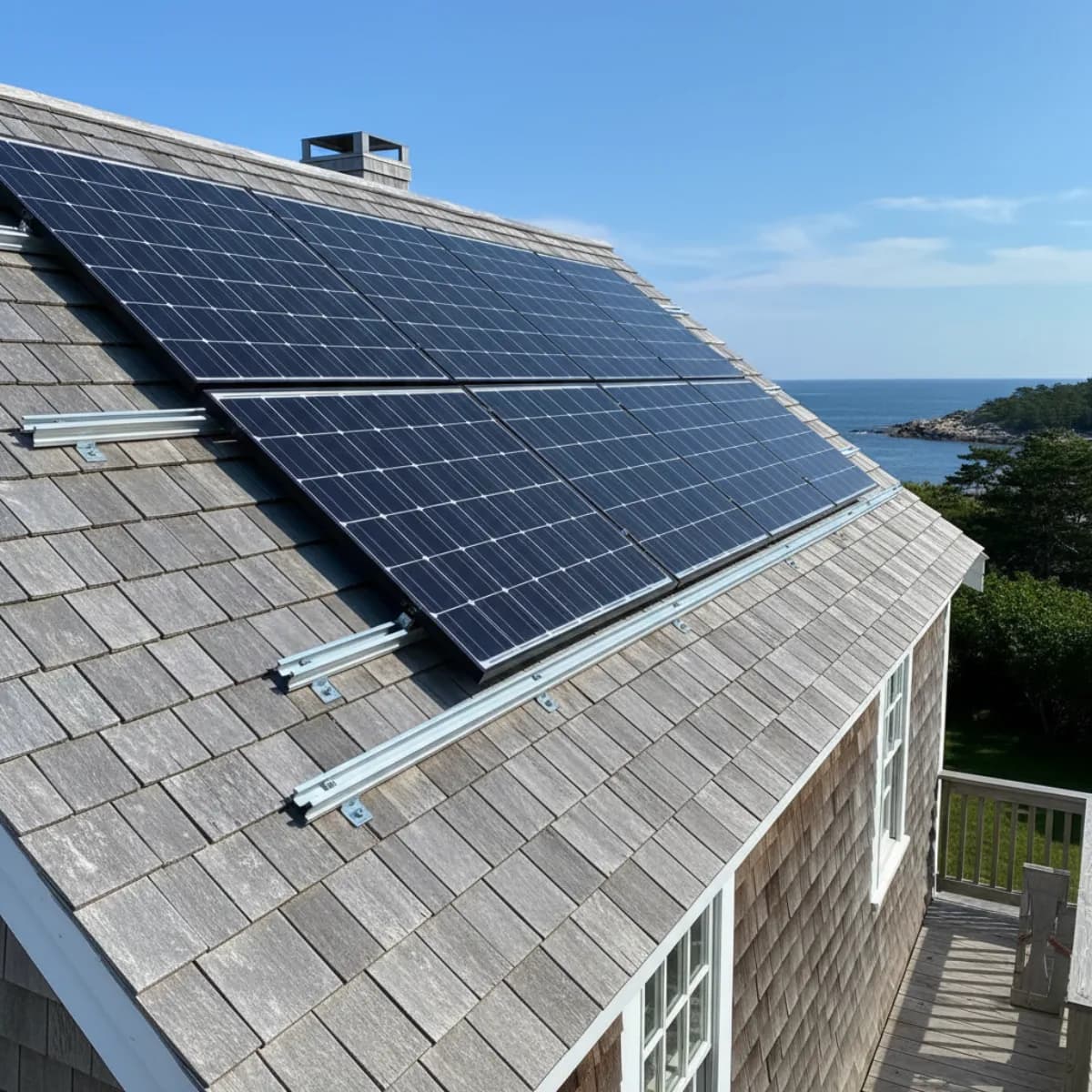
Yes. Solar panels can be installed on cedar shingle roofs using rail-mounted systems with stainless steel lag bolts and specialized flashing. Expect a cost premium of $0.50-$1.00/W (about $4,000-$8,000 extra for a typical system) due to the softer wood, moisture expansion, and fire code requirements. Your cedar roof should have at least 15 years of remaining life. If it is older than 25-30 years, consider re-roofing first. Cape Cod, South Shore, and North Shore homeowners with cedar roofs should work with installers specifically experienced in cedar roof mounting -- not all solar companies have this expertise.
Cedar is a fundamentally different roofing material than asphalt shingles. Understanding these differences explains why solar installation on cedar costs more and requires specialized expertise.
Cedar absorbs and releases moisture far more than asphalt, expanding up to 1/8" per shingle. Mounting hardware must accommodate this movement without cracking the wood or breaking the waterproof seal. Rigid mounts used on asphalt can split cedar over time.
Cedar is significantly softer than the plywood sheathing underneath. Lag bolts can over-torque and strip in cedar. Installers must drill pilot holes and use precise torque settings. Stainless steel hardware is required to prevent galvanic corrosion with cedar tannins.
Untreated cedar is Class C (the lowest fire rating). Massachusetts building code requires fire-resistant barriers between cedar and solar equipment. This typically means comp shingle or non-combustible material at all mounting points and along maintenance pathways.
Cedar relies on overlapping layers and natural water-shedding rather than the adhesive seal of asphalt. Every penetration point needs specialized flashing that works with cedar's layered drainage pattern. Standard asphalt flashing boots do not work on cedar.
There are three proven approaches to mounting solar panels on cedar shingle roofs. The right choice depends on your roof age, shingle condition, and local fire code requirements.
The most common and recommended approach. Cedar shingles are carefully lifted at each mounting point, a section of composition (asphalt) shingle is slid underneath, and the stainless steel lag bolt penetrates through both layers into the roof sheathing. The comp shingle provides a fire-resistant barrier and improved waterproofing at each penetration.
Uses specialized flashings designed for thick wood shingles (such as Quick Mount PV Cedar Mount). The flashing slides under the cedar courses above the penetration point and seals against the shingle surface. Fewer modifications to the cedar surface but requires high-quality sealant.
Uses weighted mounting without any roof penetrations. Only viable for low-slope (near-flat) cedar roofs, which are rare in Massachusetts residential construction. More common on commercial flat-roof cedar sections.
How cedar compares to other common Massachusetts roof types for solar installation cost, compatibility, and longevity.
| Roof Type | Solar Cost/W | Labor Premium | Roof Lifespan | Compatibility | Notes |
|---|---|---|---|---|---|
| Asphalt Shingle | $2.80-$3.50/W | None (baseline) | 20-30 years | Excellent | Standard mounting. Most common roof in MA. |
| Cedar Shingle/Shake | $3.30-$4.50/W | +$0.50-$1.00/W | 30-50 years | Good (with care) | Requires specialized flashing and sealant. |
| Standing Seam Metal | $2.60-$3.20/W | -$0.20-$0.30/W | 40-70 years | Excellent | S-5 clamps, no penetrations needed. |
| Slate | $3.50-$5.00/W | +$0.70-$1.50/W | 75-200 years | Difficult | Fragile tiles. Specialized brackets required. |
| Flat/EPDM/TPO | $3.00-$3.80/W | +$0.20-$0.30/W | 20-30 years | Good | Ballasted or attached systems. |
Cedar roofs age differently depending on maintenance, sun exposure, salt air exposure, and whether the shingles are pressure-treated. Here is how to assess whether your cedar roof can support solar.
Cedar roofs last 30-50 years. Solar panels last 25-30 years. Ideally, install solar when your cedar roof has at least 25 years of remaining life so both investments age together. If your cedar roof has 10-15 years left, it often makes financial sense to re-roof now (cedar or asphalt) and install solar simultaneously. The cost of removing and reinstalling solar for a future roof replacement ($3,000-$6,000) is avoidable with proper timing.
Fire safety is the most important technical consideration for solar on cedar roofs. Massachusetts adopts the International Fire Code with state amendments, and local fire departments may impose additional requirements.
Untreated western red cedar shingles carry a Class C fire rating -- the minimum allowed. Fire-retardant treated (FRT) cedar can achieve Class A or B ratings. If your cedar is FRT-treated, fire code compliance for solar is significantly simpler. Check your original roofing documentation or have a sample tested.
For Class C cedar, Massachusetts requires a fire-resistant barrier between the roofing and solar equipment. This is typically achieved by placing composition shingle or non-combustible sheet material beneath each mounting foot and along designated fire-access pathways. The barrier must extend at least 6 inches beyond the mounting hardware in all directions.
Solar panels on cedar roofs must maintain the standard Massachusetts setbacks: 3 feet from the ridge, 18 inches from the hip/valley, and fire-department access pathways per local requirements. Some municipalities impose additional setbacks for Class C roofing. Boston, Cambridge, and several Cape Cod towns have specific cedar/solar guidelines.
All Massachusetts solar installations require NEC 690.12 rapid shutdown compliance. On cedar roofs, this is especially important for fire safety. Module-level power electronics (microinverters or DC optimizers) satisfy this requirement and are recommended for cedar installations regardless of fire classification.
Many Massachusetts towns with high cedar roof density also have historic district commissions (HDC). Cedar homes in these districts face additional requirements that affect solar panel placement, appearance, and sometimes viability.
Panels generally prohibited on street-facing roof slopes. Rear-facing or flat roof installations may be approved. Black-on-black panels required. HDC review mandatory.
Panels allowed if not visible from primary streetscape at pedestrian level. Black-on-black required. HDC certificate of appropriateness needed. Ground mount encouraged as alternative.
Panels allowed on rear-facing slopes. No restriction on panel color but flush-mount preferred. Historic district commission review required for street-visible installations.
Nantucket Historic District Commission requires case-by-case review. All installations must minimize visual impact. Ground-mount systems often preferred. Extended review timelines (60-90 days).
Panels allowed with HDC approval. Must be on rear or side slopes not visible from the primary road. Black frames required in the historic district.
MGL Chapter 40A, Section 3 limits municipal authority to restrict solar energy systems, stating they may be regulated only to protect public health and safety. However, historic districts retain some authority to regulate aesthetics. The balance between solar rights and historic preservation is an evolving area of Massachusetts law. Always file with your HDC before signing a solar contract to understand specific requirements and timelines.
If you live in these areas, there is a good chance your home has a cedar roof -- and local installers should be experienced with cedar solar installations.
| Area | Cedar Density | Example Towns |
|---|---|---|
| Cape Cod (Barnstable County) | Very High | Chatham, Wellfleet, Truro, Provincetown, Sandwich, Falmouth |
| South Shore | High | Scituate, Cohasset, Duxbury, Marshfield, Hingham |
| North Shore | High | Marblehead, Manchester-by-the-Sea, Rockport, Gloucester, Newburyport |
| Islands | Very High | Nantucket, Martha's Vineyard (all towns) |
| Historic Inland | Moderate | Concord, Lexington, Salem, Plymouth, Deerfield |
Cedar roofs already carry higher insurance premiums than asphalt due to their fire rating. Adding solar introduces additional considerations that homeowners should address proactively.
Contact your homeowner insurance company before installing solar on a cedar roof. Some insurers require notification or a rider to cover the solar equipment. A few may adjust your premium based on the combined fire risk of cedar and solar. Getting this in writing protects you in the event of a claim.
If your cedar shingles are fire-retardant treated (FRT), this can reduce both your baseline cedar roof premium surcharge and any additional concerns about solar. Some insurers offer a discount for Class A or B rated cedar compared to untreated Class C cedar.
Standard Massachusetts homeowner policies typically cover permanently attached solar panels as part of the dwelling. However, the coverage amount may need to increase to reflect the added value ($20,000-$40,000). Review your dwelling coverage limit and adjust upward if needed. Your solar installer should provide documentation of the system value for your insurer.
If your cedar roof is too old, too steep, in a restrictive historic district, or you simply prefer not to mount panels on it, several alternatives let you go solar without touching your roof.
+$0.30-$0.50/W premium
Installed in your yard on metal frames. No roof penetrations, easy maintenance access, optimal tilt angle. Requires 400-800 sq ft of unshaded yard space. Very popular on Cape Cod for cedar roof homes.
+$1.00-$2.00/W premium
Dual-purpose structure providing covered parking or outdoor living space with solar panels on top. Higher cost but adds usable covered area. No impact on roof at all.
Standard pricing
If you have a detached garage, barn, or workshop with a non-cedar roof and good sun exposure, panels can be installed there at standard pricing and connected to your home electrical panel.
No installation cost
Subscribe to a share of a local solar farm and receive credits on your electric bill. No equipment on your property. Typical savings of 5-15% on electricity. Easy to start and cancel.
Have a Cedar Roof? Get a Solar Assessment
Our team includes installers experienced with cedar shingle mounting. We will assess your roof condition, fire code requirements, and provide accurate pricing.
Yes. Solar panels can be installed on cedar shingle and cedar shake roofs using rail-mounted systems with stainless steel lag bolts and specialized flashing. The installation requires extra care because cedar is softer than asphalt and expands/contracts more with moisture changes. Expect a labor cost premium of $0.50-$1.00 per watt compared to standard asphalt shingle installation. The key is using an installer experienced with cedar roofs -- not all solar companies have this expertise.
Solar installation on a cedar roof typically costs $0.50-$1.00 per watt more than asphalt shingle installation due to additional labor time and specialized materials. For a typical 8 kW system, that is $4,000-$8,000 more, bringing the total to approximately $26,400-$36,000 vs $22,400-$28,000 on asphalt. The premium covers specialized flashing, additional sealant, comp shingle underlayment at penetrations, and slower installation pace to avoid damaging the cedar.
As a general rule, if your cedar roof has more than 15 years of remaining life, it is a good candidate for solar. Cedar roofs last 30-50 years depending on maintenance and exposure. If your cedar roof is over 25-30 years old, is heavily weathered, has significant moss/lichen growth, or has shingles that are cracking and curling, you should replace the roof before installing solar. The cost of removing and reinstalling solar panels for a later roof replacement ($3,000-$6,000) makes timing this decision important.
Most cedar shingle manufacturers warrant the shingles themselves but not the installation. A properly installed solar system with appropriate flashing should not void the shingle warranty, but the area under and immediately around the panels may be excluded from any labor warranty provided by your roofer. Get written confirmation from both your roofer and solar installer. The solar installer should warranty the waterproofing at all penetration points for a minimum of 10 years, ideally 25 years to match the solar panel warranty.
Cedar shingles are rated Class C fire resistance (the lowest) unless chemically treated. Massachusetts building code requires a fire-resistant layer between cedar and solar equipment. Most installers address this by placing comp shingle or a non-combustible material beneath the mounting hardware and along pathways. Some municipalities require additional fire setbacks or documentation. Fire-treated cedar shingles (Class A or B) simplify compliance. Always verify requirements with your local building department before installation.
Yes, but historic district commissions (HDC) in Massachusetts can regulate solar panel placement, visibility, and color. Common requirements include: panels must not be visible from the primary street view, panels may need to be black-on-black (black frames and back sheet), and ground-mount may be required if roof installation would alter the historic character. Towns like Salem, Plymouth, Marblehead, and Beacon Hill each have different rules. Massachusetts Solar Access Law (MGL c.40A, s.3) limits how much HDCs can restrict solar, but does not override all local authority. File with your HDC before signing a solar contract.
If your cedar roof is within 10-15 years of end-of-life, replacing it before solar installation often makes financial sense. Asphalt shingles cost $8,000-$15,000 for a typical home vs $20,000-$40,000 for new cedar. Switching to asphalt also eliminates the $0.50-$1.00/W solar cost premium and simplifies future maintenance. However, many homeowners on Cape Cod and in historic areas prefer cedar for aesthetic and property value reasons. A new cedar roof with solar still provides excellent long-term value -- just plan the timing so both investments align.
If your cedar roof is too old, too steep, has poor sun exposure, or is in a restrictive historic district, alternatives include: (1) Ground-mount solar in your yard ($0.30-$0.50/W premium over roof but avoids all roof issues), (2) Solar carport or pergola ($1.00-$2.00/W premium but adds usable covered space), (3) Community solar subscription (no installation, 5-15% bill savings), or (4) Detached garage or barn roof installation if available. Ground mount is the most common alternative for Cape Cod homeowners with cedar roofs that cannot support panels.
When to re-roof before installing solar and how to time both investments.
Complete pricing guide for Massachusetts solar installations by system size.
Alternative for homes where roof mounting is not ideal.
Navigating HDC requirements for solar in MA historic districts.
Get a free assessment from installers who understand cedar roofs, Massachusetts fire codes, and historic district requirements.