Loading NuWatt Energy...

We use your location to provide localized solar offers and incentives.
We serve MA, NH, CT, RI, ME, VT, NJ, PA, and TX
Loading NuWatt Energy...
NuWatt designs, installs, and manages solar, battery, heat pump, and EV charger systems across 9 states. One company, one warranty, one point of contact.
Get a Free QuoteWhat the IEC 61215 hail standard actually tests, which Tier-1 brands hold enhanced 55mm hail certifications, how dual-glass compares to glass-backsheet in real New England weather, and the insurance-claim and ice-dam questions every MA/NH/VT/RI/ME homeowner should get straight before signing a contract.
25mm
IEC 61215 Baseline
55mm
Enhanced Max
5400 Pa
Snow Load (front)
HO-3
Insurance Path
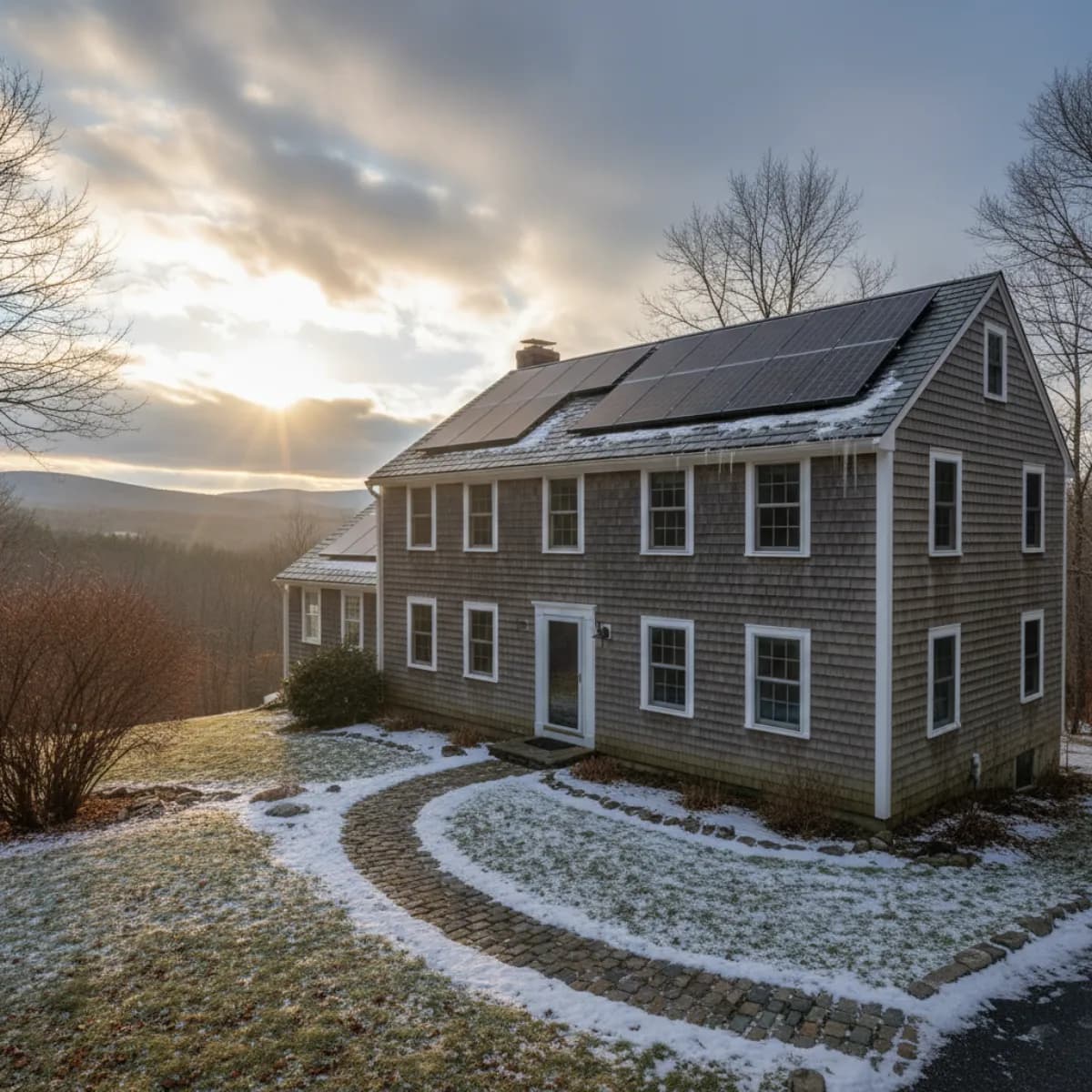
TL;DR for MA/NH/VT/RI/ME homeowners: Any Tier-1 solar panel sold in New England passes IEC 61215’s 25mm hail test. For the small fractionof sites at real risk of 1.5"+ hail (inland/hill country), enhanced-hail-certified modules or dual-glass construction are worth the 5–12% upcharge. Panels don’t cause ice dams — attic heat loss does. Hail damage is a standard homeowners claim under HO-3.
IEC 61215 is the international standard for crystalline silicon PV module qualification. It is not a single test — it is a battery of roughly 19 Module Qualification Tests (MQTs) that a module must pass to earn the IEC 61215 mark. For New England homeowners, four of those tests matter the most.
IEC 61215 Module Qualification Test 17 fires 25mm (~1") diameter ice balls at 23.0 m/s (roughly 51 mph — terminal velocity) at 11 specified cell-area and edge locations. After impact, the module must show no visible damage beyond cosmetic and must pass an insulation and wet-leakage retest. Passing this is the minimum for any Tier-1 module sold in North America.
Beyond baseline, select manufacturers submit modules to enhanced hail testing at 35mm, 45mm, or 55mm (up to ~2.17") ice balls at velocities approaching 30–40 m/s. These tests are voluntary, pass/fail, and brand-marketed when achieved. TÜV Rheinland and UL both publish enhanced hail certificates.
200 cycles between -40�C and +85�C, simulating decades of New England winter–summer swings. Checks for solder joint fatigue, cell cracking, and encapsulant delamination.
5400 Pa front load (snow), 2400 Pa rear load (wind uplift) applied for one hour per direction. Modules passing this are suitable for New England ground snow loads across the vast majority of MA, NH, VT, RI, and ME.
What IEC 61215 is not
IEC 61215 is a qualification standard — it establishes that a module design can survive defined stresses. It is not a warranty, not a field-performance guarantee, and not a substitute for installation engineering. A panel that passes IEC 61215 can still fail if racking, grounding, or roof attachments are wrong. The durability story for New England solar is half the panel and half the installer.
The table below is a snapshot — manufacturer certifications shift year to year as product lines evolve, and enhanced-hail ratings apply to specific SKUs and production runs, not blanket brand claims. Always confirm the exact certificate for the exact module model your installer is quoting.
Note: Where specific SKU availability or a current 2026 certificate is uncertain, we use hedge language and recommend you verify with the manufacturer spec sheet.
| Brand / Series | Baseline (IEC 61215) | Enhanced Hail | Construction | Notes (Confirm 2026 Listing) |
|---|---|---|---|---|
| REC Group (Alpha Pure-R) | IEC 61215 (25mm) | Enhanced hail — historically tested to 35mm+ on select SKUs | Glass-backsheet, HJT cells | Strong residential reputation in the Northeast. Confirm current 2026 certificate and SKU from manufacturer. |
| Panasonic EverVolt (HK2/HK3) | IEC 61215 (25mm) | Select SKUs listed for enhanced hail performance | Glass-backsheet, HJT cells | 25-year product + performance warranty. Confirm current listings directly with Panasonic / distributor. |
| Silfab (Prime / Elite series) | IEC 61215 (25mm) | Enhanced hail rating on select SKUs | Glass-backsheet; glass-glass on commercial SKUs | North American manufacturing. Confirm specific SKU’s enhanced-hail certificate with Silfab spec sheet. |
| Hanwha Q CELLS (Q.PEAK DUO G10+/G11+) | IEC 61215 (25mm) | Enhanced hail certification available on select SKUs | Glass-backsheet (residential); glass-glass (select commercial) | Widely deployed in MA residential. Confirm enhanced-hail SKU availability with installer — varies by production run. |
| Canadian Solar (HiKu series) | IEC 61215 (25mm) | Enhanced hail on select commercial bifacial SKUs | Glass-backsheet (residential); glass-glass bifacial (commercial) | More common on commercial projects than residential roofs in New England. |
| LG NeON (legacy — out of market) | Previously IEC 61215 (25mm) | Previously held enhanced hail ratings | Glass-backsheet | LG exited the residential solar module business in 2022. Existing arrays retain their manufacturer warranty per LG’s published end-of-market policy â but no new supply. |
| Meyer Burger (legacy — out of market) | Previously IEC 61215 (25mm) | Previously marketed for premium hail resistance | Glass-glass, HJT | Meyer Burger scaled back residential sales in 2024. Field warranty support is limited — existing homeowners should verify service paths. |
Manufacturers submit specific SKUs for enhanced-hail testing, and those SKUs are sometimes retired or replaced as product lines evolve. A certificate valid in 2023 may no longer apply to the 2026-production version of the “same” module. If enhanced hail matters to your project, ask your installer to produce the specific TÜV or UL certificate for the exact SKU and serial range shipping to your job — and don’t accept a generic brand brochure as evidence.
Two pieces of spec drive real-world hail performance: front-glass thickness and whether the module is dual-glass (glass-glass) or glass-backsheet. Here is what each means.
The residential standard. Fully tempered, heat-strengthened, and treated with an anti-reflective coating. Impact resistance is good for baseline IEC 61215 and survives routine New England weather without issue on properly engineered installations.
Used on both sides of dual-glass (glass-glass) modules. Each pane is thinner than the 3.2mm standard, but the symmetric construction sandwiches the cells and distributes impact energy better than the single-pane-plus-backsheet design. Dual-glass modules tend to perform better in enhanced hail testing and are less prone to micro-cracks over thermal cycling.
One pane of 3.2mm tempered glass on the sun side; a polymer (usually fluoropolymer) backsheet on the rear. This is still the dominant residential configuration — lighter, cheaper, and meets IEC 61215 baseline — but it cannot absorb impact through the rear the way a dual-glass module can.
Our practical take: For coastal MA, metro Boston, Cape Cod, RI, and coastal NH/ME — standard 3.2mm glass-backsheet Tier-1 modules (e.g., Q CELLS, Silfab, REC) are fine for hail. For Central and Western MA (Worcester, Franklin, Hampshire, Berkshire counties), Southern NH, Vermont, and the Champlain Valley — we recommend homeowners at least see a dual-glass option on the quote for comparison.
Hail is only one of four weather stressors that matter in the Northeast. A proper durability conversation covers summer hail, winter ice/snow loading, thermal cycling, and wind uplift.
| Stressor | Risk Level | What Matters |
|---|---|---|
| Summer Hail (May–Aug) | Moderate inland · Low coastal | IEC 61215 baseline covers typical events; enhanced hail for inland/hill country |
| Winter Ice/Snow Load | Low (for 5400 Pa modules) | Most Tier-1 modules exceed MA/NH/VT ground-snow loads by wide margin |
| Thermal Cycling (±60°F swings) | Low (designed-for condition) | IEC 61215 MQT 11 certifies 200 cycles -40°C/+85°C |
| Wind Uplift (nor’easters) | Low with proper racking | Installer engineering (ASCE 7 zone + attachment spacing) drives outcome |
New England sees fewer hail events per year than the Plains or Front Range, but severe convective cells in Central and Western Massachusetts, the Berkshires, Southern New Hampshire, and Vermont’s Champlain Valley can produce 1" to 2" stones. The 2021 Worcester County and 2023 Franklin County events each produced spot reports of quarter-sized to ping-pong-sized hail that damaged roofs, siding, and some solar arrays.
Mitigation
Specify modules that carry IEC 61215 baseline testing at minimum; prefer dual-glass or enhanced-hail-certified panels for sites in hail-prone microclimates.
Heavy wet snow, freezing rain glaze, and ice pellets are routine across New England. Solar modules are structurally rated for heavy snow loads (most Tier-1 panels: 5400 Pa front load, roughly 112 lb/ft�), which comfortably covers typical MA/VT/NH loading. Ice pellets (sleet) are lower-energy than summer hail and rarely damage certified modules.
Mitigation
Confirm snow load rating meets or exceeds your site’s ground-snow load (ASCE 7). Most of interior MA sits at 40â50 psf ground snow; 5400 Pa modules clear this with a wide margin.
Overnight lows of -10�F to -20�F in interior MA, VT, and NH, swinging to +30�F daytime in direct sun, put glass, EVA encapsulant, and cell interconnects through expansion/contraction cycles. IEC 61215 Thermal Cycling testing subjects modules to 200 cycles between -40�C and +85�C to simulate 25+ years of field exposure.
Mitigation
Any IEC 61215-certified module has passed thermal cycling. Premium modules with better cell interconnect designs (e.g., heterojunction, TOPCon) tend to show less degradation over cycled service life.
Coastal MA, RI, and coastal NH/ME see sustained winds of 40â60 mph in nor’easters and gusts above 80 mph in hurricane remnants (e.g., Irene 2011, Sandy 2012, Lee 2023 brushback). Most Tier-1 modules are rear-load rated to 2400 Pa (roughly 50 psf uplift). The failure mode is almost never the panel itself â it is the racking-to-roof attachment.
Mitigation
Match racking’s wind-zone rating (ASCE 7-16 or 7-22) to your exact zip code. Coastal MA often requires tighter attachment spacing than interior â this is an installer engineering question, not a panel question.
The good news: a standard Massachusetts HO-3 homeowners policy covers hail damage to a rooftop solar array as a named peril. The bad news: most homeowners — and many field adjusters — miss the step that separates a clean claim from a frustrating one. That step is the thermal IR scan.
Here is the sequence we walk clients through when a hail event hits one of our MA, NH, or VT installations.
Take wide-angle shots of the full array, close-ups of every visibly damaged panel, roof penetrations, and any ground debris (ice, broken branches, hail accumulation). Timestamps matter — most phone cameras embed them automatically. Do not let anyone climb on the roof before the adjuster has documentation.
Hail damage to a rooftop solar array is typically covered under a standard HO-3 homeowners policy as a named peril (windstorm and hail). Your dwelling coverage usually extends to permanently installed solar. Call your carrier the same day — some policies have reporting windows as short as 60–90 days for hail claims.
This is the step homeowners miss most. A hail strike can crack individual cells beneath intact-looking glass. Those micro-fractures show up as hotspots in an infrared scan but are invisible to the naked eye. A qualified solar O&M firm or your installer can run a thermal scan for $200–500 and produce a report the adjuster can rely on.
Manufacturer product warranty (typically 25 years for Tier-1) covers defects, not weather damage. Installer workmanship warranty (usually 10 years) covers installation quality. Neither replaces homeowners insurance for hail — but both matter for establishing baseline condition and product authenticity in a claim file.
Many insurance field adjusters are not solar specialists. An estimate from a licensed solar installer documenting the specific panel model, replacement cost, labor, electrical reconnection, permitting, and performance testing sets a credible ceiling for the claim. If the adjuster offers less, the installer estimate is your negotiating anchor.
After a hail event, storm-chaser contractors sometimes ask homeowners to sign an “Assignment of Benefits” that transfers the insurance claim rights to the contractor. This is legal but has caused problems in MA and NH. Read any AOB carefully, and prefer working with a solar installer you chose â not one that knocked on your door after the storm.
Ice dams are the most misunderstood winter-solar question we field. The short version: panels don’t cause dams, but they can change the geometry of where snow melts and refreezes. Here’s what to know before signing a contract.
Ice dams form because heat escaping from a poorly insulated attic melts snow on the warm part of the roof. That meltwater then refreezes at the cold eaves where there is no attic heat below — forming the dam. The trigger is attic heat loss, not solar. In fact, the roof under a solar array is often slightly cooler than exposed roof because the array shades it.
This is the nuance most installers do not explain. On a bare roof, snow slides incrementally. On a roof with solar, the bottom row of panels creates a physical edge. Snow above can slide off the panels but may accumulate against the bottom rail or at the eave below. On steeper roofs (8:12+) this rarely matters; on shallower pitches (4:12–6:12) it can concentrate ice-dam conditions in the un-paneled eave zone.
Mass Save covers up to 75–100% of attic air sealing and insulation costs for income-eligible MA homeowners, with generous rebates across all income tiers. A properly insulated and air-sealed attic (R-49 to R-60 in MA climate zone 5) keeps the roof deck uniformly cold, which eliminates the melt-refreeze cycle that causes ice dams — with or without solar.
Heated cables melt channels through existing dams but do not prevent them. They also use power continuously in winter. Use them only as a temporary measure while planning proper insulation work, or for hard-to-insulate architectural corners (cathedral ceilings without attic access).
NuWatt and most MA-reputable installers leave a setback — typically 12–18" — between the bottom edge of the array and the eave. This setback gives snow slide room, preserves firefighter access per Massachusetts IRC requirements, and reduces the chance of the array concentrating ice-dam conditions right above the gutter line.
Our pre-install checklist for MA homes
Before we design an array, NuWatt’s site assessment checks attic insulation depth, air sealing condition, and roof pitch. If insulation is below R-38 or air sealing is visibly poor, we recommend homeowners schedule a Mass Save assessment before installing solar — not instead of, but in sequence.
This is one of the few places where the right answer is to slow down the solar project, fix the building shell, and come back six weeks later with a better system that won’t be blamed for ice dams it didn’t cause.
The short answer: faster than most homeowners expect. Panel fronts warm noticeably above ambient in any direct sun, even through thin snow cover. But the rate depends on roof pitch, panel color, and snow type.
Usually sheds within hours of any direct sun exposure. The dark panel surface warms quickly, melting the snow-panel interface and letting the pack slide on any pitch above about 4:12.
Can stick 1–3 days on shallow-pitch roofs or during multi-day overcast stretches. A classic nor’easter leaving 18"+ of wet snow may keep arrays fully covered until temperatures rise above freezing for a sustained period.
The worst case. A thick glaze can lock to the panel surface and persist until temperatures climb well above freezing. Rarely damaging to certified modules, but it can kill production for several days.
We see this mistake every winter. The production loss from snow-covered panels is a few days in a worst case — often recovered within a week of typical Massachusetts weather. The risk of a fall, a damaged panel from a shovel strike, a scratched front glass voiding warranty, or an electrical hazard from broken wiring far outweighs any lost kWh. If your roof pitch is shallow (4:12 or less) and snow retention is chronic, talk to your installer about design adjustments, not DIY clearing.
We install across MA, NH, VT, RI, and ME. Weather specification is not an upsell — it is the baseline engineering discipline we apply on every project.
We match module spec to site: coastal sites get standard Tier-1 glass-backsheet; inland and hill-country sites get a dual-glass or enhanced-hail option on the quote. We don’t apply a single blanket SKU across every roof.
Wind-zone calculations per your exact zip code. Attachment spacing tightens in coastal zones. Eave setback and firefighter access lanes per Massachusetts IRC. No cookie-cutter layouts.
Every install gets a closeout package with module SKU, serial numbers, certificates, warranty details, and as-built photos. If you ever file a hail or wind claim, your adjuster has everything they need.
A note on warranties:Federal residential §25D solar tax credits expired December 31, 2025. Manufacturer and installer warranties remain the durable protection on your system. If an installer is still quoting §25D as an active incentive in 2026, that’s a signal to double-check the rest of the paperwork. Commercial and third-party-owned projects can still use the §48E Investment Tax Credit through the July 4, 2026 construction-start deadline.
NuWatt specifies modules, racking, and attachments to your exact microclimate — not a template. We document certifications, serial numbers, and as-built photos so future insurance claims go smoothly. And we’ll tell you honestly when dual-glass is worth the upcharge and when it isn’t.
Serving Massachusetts, New Hampshire, Vermont, Rhode Island, and Maine.
Last updated: April 2026
Sources: IEC 61215:2021, TÜV Rheinland enhanced-hail certificates, UL 1703/61730, ASCE 7-22, NOAA/NWS storm reports, Mass Save program docs, manufacturer spec sheets