Loading NuWatt Energy...

We use your location to provide localized solar offers and incentives.
We serve MA, NH, CT, RI, ME, VT, NJ, PA, and TX
Loading NuWatt Energy...
NuWatt designs, installs, and manages solar, battery, heat pump, and EV charger systems across 9 states. One company, one warranty, one point of contact.
Get a Free QuoteMassachusetts Offers Rebates for Electric Vehicles (MOR-EV) is the state’s post-purchase rebate for new and used battery-electric and fuel-cell vehicles. Administered by the Center for Sustainable Energy (CSE) for MassDEP. Stack the Standard rebate with the MOR-EV+ income adder and the Trade-In bonus, then add a Mass Save / utility EV charger rebate on your Level 2 charger.
$3,500
Standard Rebate (New/Used)
+$1,500
MOR-EV+ Income Adder
+$1,000
Trade-In Bonus
$0
Federal EV Credit (Repealed)
Federal EV Credits Repealed: The Section 30D new clean vehicle credit ($7,500) and Section 25E used EV credit ($4,000) were both repealed by the OBBBA, signed July 4, 2025. No federal EV purchase tax credits exist in 2026. Massachusetts’s MOR-EV program is now the primary purchase incentive. The Section 30C EV charger credit (up to $1,000) expired June 30, 2026 and is no longer available.
Massachusetts Offers Rebates for Electric Vehicles (MOR-EV) is the state’s flagship post-purchase rebate for new and used battery-electric and fuel-cell passenger vehicles. The program is funded by the Massachusetts Department of Environmental Protection (MassDEP) and administered on contract by the Center for Sustainable Energy (CSE).
The federal EV incentive landscape collapsed in 2025. The One Big Beautiful Bill Act (OBBBA), signed July 4, 2025, repealed both the Section 30D new-EV credit (up to $7,500) and the Section 25E used-EV credit (up to $4,000). As of 2026, there are zero federal tax credits for purchasing an electric vehicle.
This makes MOR-EV materially more important. Unlike a tax credit, MOR-EV is a direct cash rebate — you receive the money regardless of your federal tax liability. For an income-qualifying buyer with a trade-in, the combined state rebate can reach $6,000, which replaces a large portion of the old federal credit.
Program guideline note: MOR-EV’s Program Guideline is periodically updated; the most recent revision referenced in source material is dated October 8, 2025. Because the program has been tightened more than once in recent years (PHEV rules, income caps, MSRP caps), always verify the current guideline at mor-ev.org before purchasing.
MOR-EV is structured as a base rebate plus two stackable adders. Understanding which tier(s) you qualify for is the difference between receiving $3,500 and $6,000.
$3,500
New battery-electric (BEV) or fuel-cell (FCEV) passenger vehicle with MSRP at or below $55,000. Available to all Massachusetts residents regardless of income.
$3,500
Used BEV or FCEV with a final purchase price at or below $40,000. Available only to income-qualifying buyers (single $75,000 / head-of-household $112,500 / joint $150,000).
+$1,500
Stacks on top of Standard, Used, or Trucks rebate for buyers who meet income qualifications OR participate in a qualifying benefits program (MRVP, LIHEAP, SNAP, TAFDC, and similar).
+$1,000
Additional bonus for applicants who scrap or trade in a qualifying internal-combustion vehicle (ICE) at the time of the new/used EV purchase or lease. Subject to trade-in documentation requirements.
The Standard (or Used) rebate is the base. MOR-EV+ adds $1,500 for income-qualifying applicants. Trade-In adds $1,000 for qualifying ICE scrap. An income-qualifying buyer who also scraps an old gas car can receive $3,500 + $1,500 + $1,000 = $6,000 in combined MOR-EV rebates, all paid as a single disbursement from the state.
The MOR-EV Eligible Vehicle List is maintained on mor-ev.org and updated as manufacturers release new models. Below are representative examples for each category — always confirm your specific trim and model year on the official list before purchase.
Examples: Chevrolet Equinox EV, Tesla Model 3/Y (base trims), Hyundai Ioniq 5/6, Kia EV6, Nissan Leaf/Ariya, Ford Mustang Mach-E (base), VW ID.4, Subaru Solterra, Toyota bZ4X
MSRP base trim must be at or below $55,000
$3,500
Base MOR-EV
Examples: Used Tesla Model 3, Chevrolet Bolt EV/EUV, Nissan Leaf, Hyundai Kona Electric, Ford Mustang Mach-E, VW ID.4, Polestar 2
Final purchase price at or below $40,000 AND income-qualifying buyer
$3,500
Base MOR-EV
Examples: Toyota Mirai, Hyundai Nexo (note: limited hydrogen fueling infrastructure in Massachusetts)
MSRP cap applies; fueling availability is a practical constraint
$3,500
Base MOR-EV
Plug-in hybrid (PHEV) eligibility has been tightened in recent MOR-EV guideline revisions. As of the October 2025 guideline, the program focuses primarily on BEVs and FCEVs; some PHEV categories have been phased out. Because this rule has changed more than once, confirm PHEV eligibility for your specific vehicle and purchase date at mor-ev.org before you assume you qualify. Do not rely on pre-2024 MOR-EV coverage information.
Six requirements must all be met for a MOR-EV application to be approved. Missing any one of them will result in denial.
The applicant must be a Massachusetts resident at the time of purchase/lease and at application. The vehicle must be registered in Massachusetts. Out-of-state registrations are not eligible, even if the buyer later moves to MA.
Battery-electric vehicles (BEV) and fuel-cell vehicles (FCEV) are currently eligible under the MOR-EV Standard rebate. Plug-in hybrid (PHEV) eligibility has been tightened in recent program guideline revisions — verify on mor-ev.org for your purchase date.
New vehicles must have a Manufacturer Suggested Retail Price (MSRP) at or below $55,000 (base trim, before options). Used vehicles must have a final sale price at or below $40,000. Dealer add-ons and destination fees do not count toward the cap.
Applicants must own or lease the vehicle for a minimum of 36 consecutive months in Massachusetts. Leases shorter than 36 months do not qualify. Selling, transferring, or registering the vehicle out of state before 36 months triggers a rebate clawback.
New EVs must be purchased or leased from a dealer. Used EVs can be purchased from a Massachusetts-licensed dealer OR a private party, subject to additional documentation for private-party sales. Out-of-state dealer purchases have specific rules — check the current guideline.
MOR-EV is a post-purchase rebate, not a point-of-sale discount. Applications must be submitted within 90 days of the vehicle purchase or lease date through the online portal at mor-ev.org. Applications submitted after 90 days are not accepted.
MOR-EV+ adds $1,500 on top of the Standard or Used rebate for eligible Massachusetts residents. There are two paths to qualify: AGI-based income caps, or enrollment in a qualifying benefits program.
Submit your most recent federal tax return (Form 1040) showing Adjusted Gross Income (AGI) at or below the following thresholds:
Adjusted Gross Income (AGI) on most recent federal return
AGI from most recent federal return
Combined AGI on most recent federal return
Active enrollment in any of the following Massachusetts or federal benefits programs qualifies you for MOR-EV+, regardless of your most recent tax return AGI:
Submit an award letter or active-enrollment verification letter dated within the past 12 months. Benefits-program verification is typically faster to process than tax-return-based qualification.
Used EV buyers note: The $3,500 Used rebate is only available to buyers who also meet MOR-EV+ income qualifications. If you do not qualify for MOR-EV+, you cannot receive the used-vehicle rebate. A new EV at or below $55,000 MSRP may be a better option for middle-income buyers above the MOR-EV+ caps.
MOR-EV stacks with Mass Save and utility EV charger rebates from Eversource and National Grid on your Level 2 charger install. (The federal Section 30C charger credit expired June 30, 2026 and is no longer available.) The difference between a basic stack and a maximum stack is more than $2,000 — it is worth structuring the purchase deliberately.
| Incentive | Base Buyer | Income-Qualifying | Income-Qualifying + Trade-In |
|---|---|---|---|
| MOR-EV Standard (new BEV under $55K MSRP) | $3,500 | $3,500 | $3,500 |
| MOR-EV+ Income Adder | — | $1,500 | $1,500 |
| MOR-EV Trade-In Bonus (qualifying ICE scrap) | $1,000 | — | $1,000 |
| Mass Save / utility EV charger rebate (Eversource / National Grid) | Up to $800 | Up to $800 | Up to $800 |
| Best-case combined state + utility | Up to $5,300 | Up to $5,800 | Up to $6,800 |
Example: Middle-Income Family Buying a New BEV
A Worcester family with $140,000 joint AGI (under the $150K MFJ cap) buys a new Chevrolet Equinox EV (MSRP $35,000) and trades in their 2012 gas sedan. They install a Level 2 charger (cost $1,800). Their combined incentives: $3,500 MOR-EV Standard + $1,500 MOR-EV+ + $1,000 Trade-In + $700 utility charger rebate (Eversource) = $6,700 in combined incentives. Net EV cost after all incentives: roughly $28,300.
The federal Section 30C EV charger credit (30% of a Level 2 charger install, up to $1,000) expired June 30, 2026 and is no longer available for new installations. That does not leave Massachusetts drivers without help on a home charger — state and utility programs remain active and stack cleanly with MOR-EV.
MOR-EV and charger rebates are independent programs with no offset. A Massachusetts EV buyer who installs a home charger can capture both.
MOR-EV application: within 90 days of purchase. Charger rebates: apply per each program’s terms.
MOR-EV is a post-purchase rebate, not a point-of-sale discount. The process is straightforward but strict on documentation and the 90-day submission window.
Check the current MOR-EV Program Guideline at mor-ev.org/eligibility and confirm your target vehicle is on the Eligible Vehicle List. Verify the MSRP cap ($55,000 new / $40,000 used) and your own residency and income status. If you plan to claim MOR-EV+ based on benefits-program participation, gather your award letter or enrollment documentation.
Buy or lease a qualifying BEV/FCEV from a Massachusetts dealer (or out-of-state dealer that meets program rules). Make sure the lease term is at least 36 months. Retain the signed purchase/lease agreement, bill of sale, registration, and a copy of the MSRP label (Monroney sticker).
Title and register the vehicle with the Massachusetts Registry of Motor Vehicles. Obtain the MA registration and title. The registration must show a Massachusetts address matching the applicant name.
Create an account at mor-ev.org and submit the rebate application within 90 days of the purchase/lease date. Upload purchase agreement, MA registration, driver’s license, and (if claiming MOR-EV+) income documentation or benefits-program proof. If claiming the Trade-In bonus, upload trade-in documentation from the dealer.
The Center for Sustainable Energy (CSE) — the program administrator — reviews applications. Processing typically takes 8-12 weeks for complete applications. You will be contacted by email for any missing documentation. Incomplete applications that are not corrected within the deadline may be denied.
Approved rebates are paid by check or direct deposit to the applicant (not the dealer). For combined rebates (Standard + MOR-EV+ + Trade-In), the full combined amount is paid in a single disbursement. Keep documentation of the 36-month ownership requirement — CSE may audit compliance.
The most common cause of MOR-EV delays is incomplete documentation. Before you start the application, have these files ready as PDFs or clear photos: signed purchase or lease agreement, bill of sale, MSRP (Monroney) label, Massachusetts registration, driver’s license, most recent federal tax return (for MOR-EV+ income path) OR benefits award letter (for MOR-EV+ benefits path), and trade-in bill of sale (if claiming Trade-In bonus).
Massachusetts has some of the highest residential electricity rates in the country — commonly $0.28-0.34/kWh all-in for Eversource and National Grid customers. That makes EV charging more expensive from the grid here than in almost any other state, and it makes rooftop solar the single highest-ROI companion investment to an EV purchase.
A typical Massachusetts household drives 11,000-13,000 miles/year. An efficient EV uses roughly 3,500-4,200 kWh/year for that driving. At MA retail rates, that is $1,000-1,400/year just to fuel the vehicle. A properly sized solar system reduces that marginal cost to effectively zero after the system is paid off, and Massachusetts net metering credits help balance the seasonal gap between summer production and winter EV demand.
A 7-9 kW system covers typical home load plus EV charging on an annual basis. You are literally making fuel on your roof while you sleep.
Summer solar overproduction banks as credits that offset winter EV charging, when solar output is lower but driving continues.
Solar + Level 2 charger on the same project saves $400-800 in shared electrical work, permits, and mobilization versus separate installs.
10-year fuel savings: A Massachusetts household that replaces a 25-MPG gas car with an EV charged from rooftop solar typically saves $25,000-35,000 over 10 years versus continuing to buy gasoline at current MA prices. Add the MOR-EV rebate up front, and the combined economics beat almost any alternative residential investment.
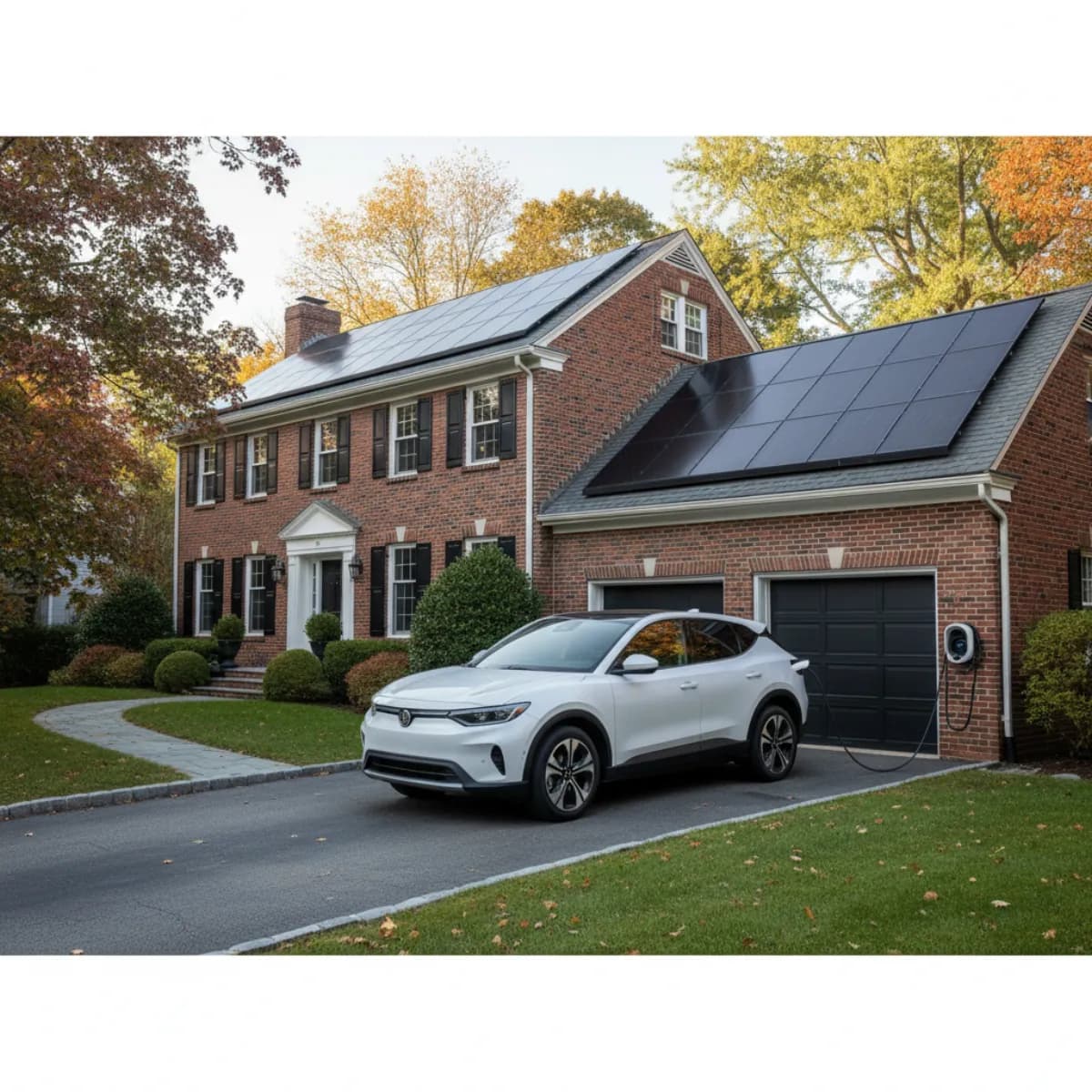
Pair your new EV with rooftop solar and a Level 2 charger. Massachusetts electricity rates are among the highest in the country — which means solar-powered EV charging pays back faster here than almost anywhere else. NuWatt designs, permits, and installs solar + EV charger bundles across Massachusetts.
The federal Section 30C charger credit (up to $1,000) expired June 30, 2026 and is no longer available; Mass Save / utility charger rebates remain. Apply for MOR-EV within 90 days of purchase.
Last updated: April 2026
Sources: MOR-EV Program Guideline (mor-ev.org), MassDEP, Center for Sustainable Energy, IRS Section 30C, OBBBA P.L. 119 (July 4, 2025)