Loading NuWatt Energy...

We use your location to provide localized solar offers and incentives.
We serve MA, NH, CT, RI, ME, VT, NJ, PA, and TX
Loading NuWatt Energy...
NuWatt designs, installs, and manages solar, battery, heat pump, and EV charger systems across 9 states. One company, one warranty, one point of contact.
Get a Free Quote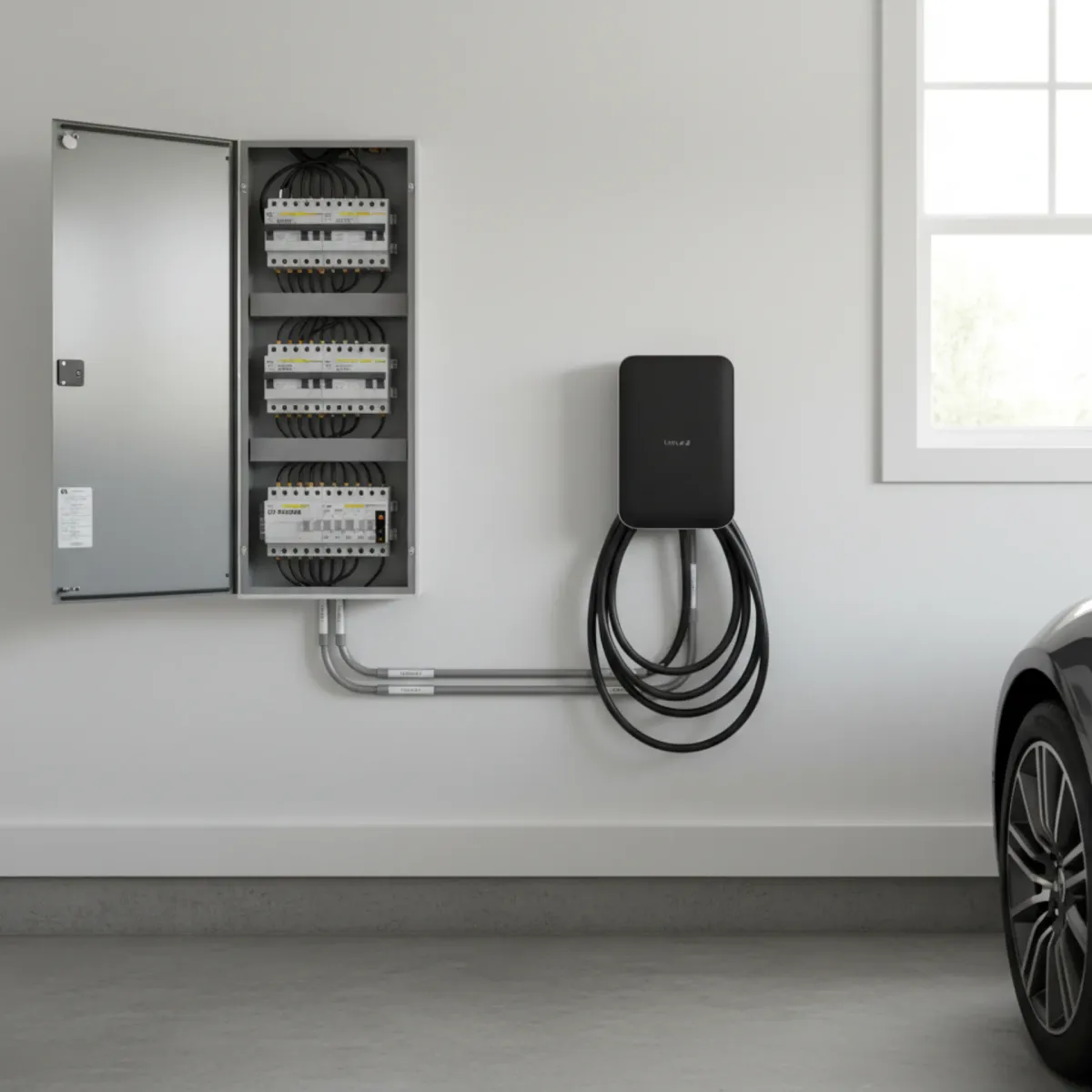
The 30% residential Section 30C credit expired June 30, 2026 and is no longer available for new installs. For a system placed in service on or before that date, a new electrical panel dedicated to your EV charger qualified — along with conduit, wiring, and labor that solely serviced the charger. Here is exactly what counted, what did not, and the invoice language that supported the claim. State and utility EV-charger rebates remain live incentives worth pursuing.
Expired June 30, 2026
the residential credit is no longer available for new installs
30%
$1,000
$2,000
$0
Quick Answer
The residential Section 30C tax credit expired June 30, 2026 and is no longer available for new installs. For a system placed in service on or before that date, a new electrical panel dedicated to your EV charger qualified for the 30% credit (capped at $1,000 per charging port). The IRS listed 'new electrical panels dedicated to the charger' and 'conduit and wiring solely servicing the charger' as eligible associated property, alongside the charger itself, wall mount, and installation labor. A whole-home main service upgrade qualified only for the portion directly traceable to the charger circuit. If you installed by the deadline, claim it on that tax year's return via Form 8911. State and utility EV-charger rebates and off-peak charging rates remain available now.
IRS Alternative Fuel Vehicle Refueling Property Credit guidance, last updated March 13, 2026 — the residential credit expired June 30, 2026
The credit covered electric vehicle charger equipment, labor costs for installation, and “associated property that is directly attributable and traceable to” the charger, including wall mounts supporting the charging port, new electrical panels dedicated to the charger, and conduit and wiring solely servicing the charger.
The 26 USC §30C statute itself defined “qualified alternative fuel vehicle refueling property” broadly and expressly preserved eligibility for bidirectional charging equipmentcapable of discharging electricity back to an external load. The IRS's “directly attributable and traceable” standard was the operative test for what associated property qualified. The residential credit expired June 30, 2026 and is no longer available for new installs — these rules now apply only to systems placed in service on or before that date.
How each line item on an electrician's quote mapped to its IRS category and the rule that decided whether it counted toward the §30C credit — for systems placed in service on or before June 30, 2026, when the residential credit expired.
| Item | IRS Category | Status | Requirement |
|---|---|---|---|
| Level 2 EV charger (new) | Qualified refueling property | Eligible | New, not used or refurbished; original use must begin with taxpayer |
| Bidirectional / V2H charger | Qualified refueling property | Eligible | §30C explicitly preserves eligibility for bidirectional equipment |
| Sub-panel dedicated to EV charger | Associated property (directly attributable) | Eligible | Panel must serve only the charger — no other loads on the bus |
| Conduit running to the charger | Associated property (directly attributable) | Eligible | Conduit must solely service the charger circuit |
| Wire from panel to charger | Associated property (directly attributable) | Eligible | Wire run terminates at the charger; not shared with other loads |
| Wall mount or pedestal | Associated property (directly attributable) | Eligible | Physical support specifically for the charging port |
| Permit, inspection, and electrician labor | Installation cost | Eligible | Labor and fees for the qualified install scope are creditable |
| Whole-home 200A main service upgrade | Mixed-use service equipment | Partial | Only the dedicated portion attributable to the charger; itemize on invoice |
| Used or refurbished EV charger | Fails "original use" rule | Not Eligible | Original use must begin with the taxpayer — not pre-owned |
| Address outside eligible census tract | Fails location requirement | Not Eligible | Property must sit in low-income community or non-urban tract |
| Generator interlock, transfer switch (general) | Not refueling property | Not Eligible | Backup-power equipment is outside §30C scope |
| Wi-Fi / smart-home hub (general) | Not directly attributable | Not Eligible | General-purpose smart-home equipment fails traceability test |
Source: IRS Alternative Fuel Vehicle Refueling Property Credit for Individuals (updated Mar 13, 2026) and 26 USC §30C as amended July 4, 2025.
The residential credit was 30% of qualified cost, capped at $1,000 per charging port — it expired June 30, 2026 and is no longer available for new installs. The cap was the binding constraint for most installs that included a panel upgrade. The three scenarios below use typical-install estimates (not bound quotes) to illustrate how the math worked for a system placed in service by the deadline.
Sufficient panel space, short wire run, no upgrade needed
Below cap — full 30% applies
Your Credit: $450
Main panel near capacity — install sub-panel solely for EV
Cap binds — credit limited
Your Credit: $1,000
V2H charger with dedicated backup-capable sub-panel
Cap binds — credit limited
Your Credit: $1,000
Why the $1,000 cap bound so often: the cap was reached when qualified costs hit ~$3,334 per port. A residential install that added a dedicated sub-panel (typically $1,800–$3,000 installed) plus a $500–$800 charger plus permit/labor cleared that threshold easily. Multi-port installs unlocked $1,000 per port, so a 2-port wall-mount setup with a shared dedicated sub-panel could recover up to $2,000. This residential credit expired June 30, 2026.
Documentation, not policy, killed most §30C claims for by-deadline installs. The rules were simple — but the IRS “directly attributable and traceable” standard required that the paperwork show the dedicated nature of the panel and wiring. (The residential credit itself expired June 30, 2026.)
IRS cannot verify which portion of "electrical work $4,100" is directly attributable to the charger. Whole bundle at risk.
A 100A→200A main panel serves the whole house. The full cost fails the "directly attributable and traceable" test. Only the dedicated portion qualified.
No part of the install qualified regardless of how it was documented. Confirm with the DOE AFVR locator when supporting a prior-year claim.
Ordering, paying deposits, or rough-in by the deadline did not count. The system had to be fully installed, inspected, and energized on or before June 30, 2026 — the residential credit expired that day.
Original use must begin with the taxpayer. Even a returned-and-restocked unit can fail this test if it was previously installed.
General-purpose equipment fails the traceability requirement. Keep them off the §30C-related invoice line items.
If you installed on or before June 30, 2026 and still need to file, this is the invoice language that supports a §30C claim. Itemized invoices with explicit “dedicated” language survive IRS review; lump-sum invoices do not. (The residential credit has since expired for new installs.)
Invoice Checklist for Your Electrician
Itemize each line: charger model + amperage, dedicated sub-panel (with capacity), wire/conduit run, labor hours, permit fee, inspection fee.
For the panel line, explicitly write: "Sub-panel dedicated to EV charger circuit — no shared loads."
For wiring/conduit, write: "Conduit and wire solely servicing the EV charger feed from panel to charger location."
Reference Section 30C: "Installation supports Internal Revenue Code §30C Alternative Fuel Vehicle Refueling Property Credit eligibility."
Document the placed-in-service date: the calendar date the system was energized, inspected, and operational.
List the property address exactly as on tax records — needed when verifying census tract eligibility on Form 8911.
Why this matters:for a by-deadline install, the credit is claimed on Form 8911 against your federal tax return. If the IRS audits or queries, the invoice is the primary document supporting the claim. “Electrical work — $4,100” is a weak claim. An itemized invoice with the panel and wiring identified as dedicated to the EV charger is a strong one.
Section 30C used a “placed in service” rule, not a contract-date rule. The charger and any dedicated panel had to be fully installed, inspected, and energized on or before June 30, 2026 to qualify — the residential credit expired that day. If you installed by the deadline, here is what to document; if you did not, here are the incentives that remain.
For a system placed in service on or before June 30, 2026, pull your itemized invoice and verify the installation address in the DOE AFVR Property Eligibility Locator. Both are needed to support the federal §30C claim on the qualifying year's return.
The date the charger and any dedicated panel were fully installed, inspected, energized, and operational is what governs the claim. Keep permits, inspection sign-off, and the dated invoice together for Form 8911.
Many states and utilities in NuWatt service territories still offer make-ready and EV-charger rebates independent of the federal credit. These are the live incentives to pursue now — ask your electrician or NuWatt which programs apply to your address.
Time-of-use and off-peak EV charging rates from your utility can materially lower per-mile charging cost. Enrolling a dedicated EV circuit in an off-peak plan is often the largest ongoing saving now that the federal residential credit has ended.
The residential Section 30C credit expired June 30, 2026 and is no longer available for new installs. Section 25D (solar) and 25C (efficiency) expired December 31, 2025. State, utility, and commercial incentives are where value remains.
For any by-deadline claim, none of this mattered if the address failed the §30C census tract requirement. The property had to sit in either a low-income community (Section 45D(e)) or a non-urban tract. The qualifying area was much broader than most people expected — many suburban and rural ZIPs qualified.
Run the installation address through the DOE's AFVR Property Eligibility Locator when supporting a prior-year claim. If the address failed, the credit was unavailable regardless of panel upgrades or documentation. The residential credit expired June 30, 2026.
If you placed a charger in service on or before June 30, 2026, the credit is claimed on IRS Form 8911 with the federal return for that tax year (the residential credit has since expired). Attach itemized invoices, the placed-in-service date, and address documentation. The credit flows to Form 1040 and reduces tax liability dollar-for-dollar — it is non-refundable, so you need tax owed to absorb it.
Talk to a tax preparer if your install spans calendar years (deposit in 2025, completion in 2026) or if you are claiming a partial credit on a mixed-use service upgrade.
Our complete Section 30C deadline page covers census tracts, qualifying chargers, Form 8911 process, residential vs commercial caps, and the bundled-with-solar question.
It did — when the new panel was dedicated to the EV charger. Note: the residential Section 30C credit expired June 30, 2026 and is no longer available for new installs. For installs placed in service on or before that date, IRS guidance for Section 30C (last updated March 13, 2026) listed "new electrical panels dedicated to the charger" as eligible "associated property that is directly attributable and traceable" to the qualified refueling property. A whole-home main service upgrade that happened to power the charger plus the rest of the house did not fully qualify — only the portion directly traceable to the charger was creditable. A separate sub-panel installed solely to feed the charger was the cleanest qualifying configuration.
The residential Section 30C credit — which expired June 30, 2026 and is no longer available — was 30% of total qualified cost, capped at $1,000 per charging port. Two ports doubled the cap to $2,000. The $1,000 cap was reached when qualified costs hit about $3,334 per port, which most full installs with a dedicated panel exceeded. The dollar cap was the binding constraint for most homeowners with panel upgrades.
Yes, for installs placed in service by June 30, 2026 (the residential credit has since expired). IRS guidance explicitly listed "conduit and wiring solely servicing the charger" as eligible associated property. The wiring run from the panel (or sub-panel) to the charger, the conduit protecting that run, and the wall mount or pedestal supporting the unit were all creditable as long as they served only the charger.
No, not all of it. A main service upgrade (e.g., 100A to 200A) serves the entire home, not just the charger, so it failed the IRS "directly attributable and traceable" test. Under the (now-expired) residential credit, the qualifying approach was either (a) install a dedicated sub-panel for the charger downstream of the existing main, or (b) have your electrician itemize the portion of the upgrade work attributable to the charger circuit. The dedicated portion had to be documented clearly on the invoice. For any past-year claim, consult a tax professional before filing Form 8911.
Yes, for installs placed in service by June 30, 2026 (the residential credit has since expired). Section 30C explicitly included labor costs for installing the qualified refueling property and its directly attributable associated property. That covered electrician labor for hanging the charger, pulling conduit, running wire from the dedicated panel, and final connections.
The statute (26 USC §30C) defined qualified refueling property by reference to the underlying equipment, and the IRS interpreted "directly attributable and traceable" associated property as eligible. The IRS's 2026 residential guidance specifically named "wall mounts supporting the charging port," "new electrical panels dedicated to the charger," and "conduit and wiring solely servicing the charger." The statute also expressly preserved eligibility for bidirectional charging equipment. The residential credit expired June 30, 2026 and is no longer available for new installs.
For an install placed in service by June 30, 2026, the invoice should itemize each cost component, identify the dedicated nature of any panel or sub-panel, reference Section 30C, and document the placed-in-service date. Generic lump-sum invoices ("electrical work $4,100") are weak support for a past-year claim. Itemized invoices with the panel and wiring identified as dedicated to the EV charger are strong. See the invoice-language checklist on this page.
No. The Section 30C credit required the installation address to be in an IRS-eligible census tract — either a low-income community (Section 45D(e)) or a non-urban tract. If the address failed census eligibility, neither the charger nor the panel upgrade qualified for §30C, regardless of how the work was documented. (The residential credit has since expired June 30, 2026.) You can still verify past eligibility with the DOE AFVR Property Eligibility Locator when supporting a prior-year claim.
Both the charger and any dedicated panel had to be "placed in service" on or before June 30, 2026 — the residential credit expired that day and is no longer available for new installs. Placed in service means fully installed, inspected, energized, and operational — not just ordered or partially wired. Installs whose permits or final inspection landed after June 30, 2026 do not qualify. Only systems energized on or before the deadline are creditable, claimed on that tax year's return.
Possibly — Section 30C used a "placed in service" rule rather than a date-paid rule. If the panel and charger were installed and operational in tax year 2024 or 2025, the credit is claimed on that year's return using Form 8911. If the system was placed in service on or before June 30, 2026, the credit is claimed on the 2026 return. Systems placed in service after June 30, 2026 do not qualify — the residential credit expired that day. Talk to your tax preparer if the work crossed calendar years or if you have not yet filed for the qualifying year.
The residential §30C credit expired June 30, 2026, but NuWatt still installs Level 2 EV chargers across MA, CT, NH, RI, VT, ME, NJ, PA, and TX — including dedicated sub-panel work, permit handling, and help capturing state and utility EV-charger rebates and off-peak charging rates. Free site assessment, no obligation.
We handle permits, dedicated panel design, inspection scheduling, and state/utility rebate paperwork.
Section 30C Deadline — Complete Guide
The full June 30, 2026 deadline guide: census tracts, qualifying chargers, Form 8911, residential vs commercial.
EV Charger Tax Credit 2026
Top-of-funnel explainer covering the 30% credit, $1,000 cap, and how to claim.
EV Charger Installation Cost Guide
Realistic 2026 cost ranges for equipment, labor, permits, and panel upgrades.
Tesla vs ChargePoint vs Emporia
Head-to-head specs on the three most-installed home Level 2 chargers in 2026.
Bidirectional Charging (V2H) Guide
§30C explicitly permits bidirectional chargers. Here is when they make economic sense.
200A Panel Upgrade Guide
How a main service upgrade actually works — and what portion qualifies for §30C when EV is added.
Sarah tracks state and federal energy incentives, utility rate structures, and rebate programs. She has helped hundreds of homeowners navigate complex incentive stacks.