Loading NuWatt Energy...

We use your location to provide localized solar offers and incentives.
We serve MA, NH, CT, RI, ME, VT, NJ, PA, and TX
Loading NuWatt Energy...
NuWatt designs, installs, and manages solar, battery, heat pump, and EV charger systems across 9 states. One company, one warranty, one point of contact.
Get a Free QuoteComplete guide to commercial net metering in Connecticut: retail rate credits up to 2MW, virtual net metering for multi-site businesses, SCEF community solar, Eversource vs UI billing mechanics, and PURA rate proceedings affecting commercial solar economics.
Net Metering Cap
2 MW
Maximum system size
Credit Rate
Retail
Full retail rate credit
Avg Commercial Rate
$0.221/kWh
CT commercial average
Netting Period
Annual
Monthly netting + annual true-up
Connecticut provides full retail rate net metering credits for commercial solar systems up to 2MW. Excess generation is credited kWh-for-kWh at the full retail rate (supply + transmission + distribution), carried forward monthly with an annual true-up. Both Eversource (~75% of CT) and United Illuminating (southwest CT) follow PURA-regulated net metering rules. Virtual net metering allows credits to be applied across multiple meters owned by the same account holder. Demand charges ($8-$18/kW/month) are NOT offset by net metering. SCEF (Shared Clean Energy Facility) community solar offers an alternative for businesses without suitable rooftops. At $0.221/kWh average commercial rates, net metering makes CT one of the strongest markets for commercial solar ROI.
Connecticut's net metering policy provides commercial solar system owners with full retail rate credits for excess electricity exported to the grid. This means every kilowatt-hour your solar system produces beyond your immediate building consumption earns a credit equal to what you would have paid for that kWh from the utility — including supply, transmission, and distribution charges. At Connecticut's average commercial electricity rate of $0.221/kWh, this represents significant value.
The mechanics are straightforward: your building consumes electricity from solar first (this is the most valuable use, as it directly offsets purchases). When production exceeds consumption — typically midday on sunny days — excess kWh flow to the grid and your meter tracks the export. At month end, you receive a credit for all exported kWh at the full retail rate. If your bill has excess credits, they carry forward to the next month. At the end of your annual billing cycle, remaining credits are trued up at the utility's avoided cost of generation — a lower rate.
This structure creates a clear economic optimization: size your system to match annual consumption, not exceed it significantly. A system producing 100% of your annual consumption maximizes the value of every kWh. A system producing 130% generates excess that is compensated at a lower annual true-up rate. Connecticut allows commercial net metering for systems up to 2MW, regulated by PURA and administered by Eversource and United Illuminating (UI).
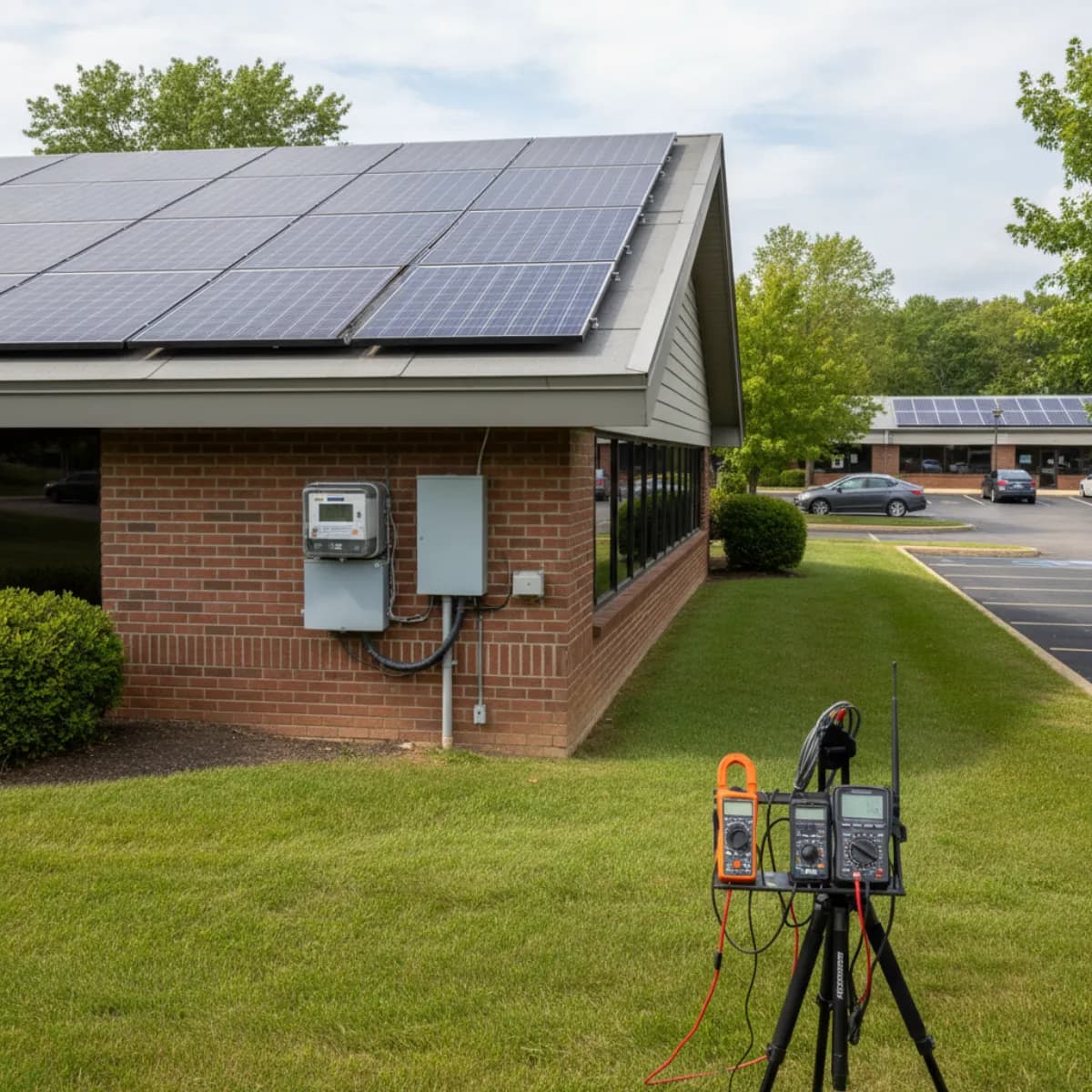
Understanding which bill components are offset by net metering — and which are not — is essential for accurate commercial solar economics. The distinction between volumetric charges (credited) and demand/fixed charges (not credited) is the single most important factor in financial modeling.
| Bill Component | Typical Rate | Net Metering Credit? | Notes |
|---|---|---|---|
| Generation/Supply Charge | $0.10-$0.14/kWh | Yes | Credited at full retail rate under net metering |
| Transmission Charge | $0.02-$0.04/kWh | Yes | Credited at retail rate; volumetric component |
| Distribution Charge | $0.06-$0.10/kWh | Yes | Credited at retail rate; volumetric component |
| Demand Charges | $8-$18/kW/mo | No | NOT offset by net metering — requires battery storage or load management |
| Customer Charge | $15-$45/mo | No | Fixed monthly charge regardless of consumption or generation |
| Non-Bypassable Charges | $0.01-$0.02/kWh | No | System benefit charges, renewable energy charges, etc. |
For many CT commercial customers, demand charges represent 20-40% of the total electricity bill. These charges are based on your peak 15-minute power draw during the billing period and are NOT reduced by solar net metering. A commercial building that peaks at 200 kW during a cloudy afternoon pays the same demand charge whether it has solar or not. Adding battery storage can reduce demand charges by 30-60%, providing savings that complement net metering. This is why proper commercial solar financial modeling must account for demand charges separately.
Connecticut is served by two investor-owned utilities: Eversource (approximately 75% of the state, 1.27 million customers) and United Illuminating (UI) (southwest CT, approximately 340,000 customers). Both follow PURA-regulated net metering rules, but there are differences in rate structures, interconnection processes, and service territories that affect commercial solar economics.
| Feature | Eversource CT | United Illuminating (UI) |
|---|---|---|
| Service Territory | ~75% of CT (1.27M customers) | Southwest CT (~340K customers) |
| Commercial Rate (avg) | $0.22-$0.28/kWh blended | $0.24-$0.30/kWh blended |
| Net Metering Credit | Full retail rate (supply + delivery) | Full retail rate (supply + delivery) |
| Maximum System Size | 2 MW | 2 MW |
| Virtual Net Metering | Yes — multi-meter, same account holder | Yes — multi-meter, same account holder |
| Excess Credit Handling | Carried forward monthly; annual true-up | Carried forward monthly; annual true-up |
| Interconnection Timeline | 8-16 weeks (capacity-dependent) | 8-14 weeks (capacity-dependent) |
| Demand Charges | Separate — not offset by net metering | Separate — not offset by net metering |
Covers Hartford, New Haven (partial), Middlesex, New London, Windham, Tolland, and Litchfield counties. Largest CT utility with the most commercial solar interconnections. Blended commercial rates of $0.22-$0.28/kWh make solar economics strong across the entire territory. Eversource processes the majority of CT commercial net metering applications.
Serves Bridgeport, New Haven (partial), West Haven, Milford, Stratford, Shelton, Ansonia, Derby, and surrounding towns in southwest CT. Higher blended rates ($0.24-$0.30/kWh) make per-kWh net metering credits more valuable. Smaller territory means fewer interconnection requests and often faster processing for straightforward projects.
Virtual net metering is a powerful tool for Connecticut commercial solar customers with multiple meters or locations. Instead of limiting solar credits to the meter where the system is installed, virtual net metering allows excess credits to flow to other meters owned by the same customer within the same utility territory.
Step 1:Solar system is installed on one property (the "host" meter) — typically the building with the best solar exposure or most available roof area.
Step 2: Production first offsets consumption at the host meter (direct consumption is always the most valuable use).
Step 3:Excess credits beyond the host meter's consumption are allocated to designated "beneficiary" meters owned by the same account holder.
Step 4: Each beneficiary meter receives credits that reduce its electricity bill at the full retail rate.
Virtual net metering in CT requires all meters (host and beneficiary) to be held by the same account holder within the same utility territory. If your business operates under different legal entities at different locations, the meters may not qualify for virtual net metering. In that case, SCEF (community solar) or separate on-site systems may be better options. Consult with your utility and installer to confirm eligibility before designing a virtual net metering system.
The Shared Clean Energy Facility (SCEF)program is Connecticut's community solar framework, offering an alternative path for businesses that cannot install on-site solar. SCEF allows commercial customers to subscribe to a portion of a larger solar facility and receive bill credits proportional to their subscription — without any rooftop equipment, construction, or maintenance responsibilities.
While Connecticut provides full retail rate net metering credits, direct consumption of solar electricity is always more valuable than exporting to the grid. Understanding this hierarchy is critical for system sizing and maximizing your commercial solar ROI.
$0.221/kWh + demand savings
Solar powers your building directly, avoiding all utility charges including demand charge contribution. Most valuable use.
$0.18-$0.24/kWh credit
Excess kWh exported to grid earns retail rate credit (volumetric only — demand charges not offset).
$0.04-$0.08/kWh
Remaining annual excess compensated at avoided cost of generation. Significantly lower value.
For optimal economics, size your system to offset 80-100% of annual consumption. This maximizes the proportion of high-value direct consumption and full-retail net metering credits while minimizing lower-value annual true-up excess. For businesses with seasonal usage patterns (e.g., summer AC loads), the match between solar production profile and consumption profile matters as much as total annual kWh.
With CT commercial rates averaging $0.221/kWh and annual production of approximately 1,175 kWh per kW installed, a 100 kW system produces roughly $27,400 in annual electricity value. At $1.60-$1.90/W installed cost for mid-size systems, the simple payback before incentives is approximately 6-7 years — and the ITC plus MACRS reduce this to 3-4 years for tax-paying entities.
The Public Utilities Regulatory Authority (PURA)is Connecticut's utility regulator and oversees net metering policy, rate design, and interconnection standards. PURA periodically reviews distributed generation compensation mechanisms as solar adoption grows and grid economics evolve. For commercial solar investors in 2026, understanding PURA's direction on successor tariff design is important for long-term financial planning.
PURA has explored methodologies for calculating the actual grid value of distributed solar — considering energy value, capacity value, transmission and distribution avoided costs, environmental value, and grid services. A VDG-based export rate could be higher or lower than current retail net metering depending on time of day and season.
PURA has considered time-varying rates that would value solar production based on when it occurs. Solar peaks midday but CT grid demand peaks late afternoon (summer) and morning (winter). TOU rates could reduce midday solar export value while increasing value of battery-shifted evening generation.
Systems installed under current net metering rules are generally expected to be grandfathered for a defined period (typically 20 years or system life). This provides investment certainty for commercial solar projects installed in 2026 — your net metering structure is locked in regardless of future policy changes.
Bottom line for 2026:Current retail rate net metering is in effect and projects installed now are expected to be grandfathered. However, the trend nationally is toward more nuanced export compensation. Installing commercial solar in 2026 locks in today's favorable net metering structure and avoids potential future rate design changes that could reduce export credit value. This pairs with 100% first-year bonus depreciation (permanent under OBBBA), which lets a business deduct the full depreciable basis in the year the system is placed in service.
Complete guide: ITC stacking, pricing, financing, and ROI for CT commercial solar.
100% financing via property tax assessment — ideal for net metered commercial systems.
Model your Eversource or UI rate structure and calculate net metering savings.
Full IRR model including net metering value, demand charges, ITC, and MACRS.
Connecticut commercial net metering allows businesses with solar systems up to 2MW to receive full retail rate credits for excess electricity sent to the grid. When your solar system produces more than your building uses, the excess is exported to the grid and you receive a kWh-for-kWh credit on your Eversource or UI bill at the full retail rate (supply + delivery charges). Credits are carried forward monthly and trued up annually. Demand charges and fixed customer charges are NOT offset by net metering.
NuWatt designs systems optimized for your specific utility rate structure, load profile, and net metering economics. Free site assessment for Eversource and UI territories.