Manufacturing & food production
What roof, structural, and electrical work is needed alongside the solar installation?

We use your location to provide localized solar offers and incentives.
We serve MA, NH, CT, RI, ME, VT, NJ, PA, and TX
Loading NuWatt Energy...
Use the free estimator for a preliminary layout, or share your preferred response method with the commercial team. Final feasibility still requires site, utility, and engineering review.
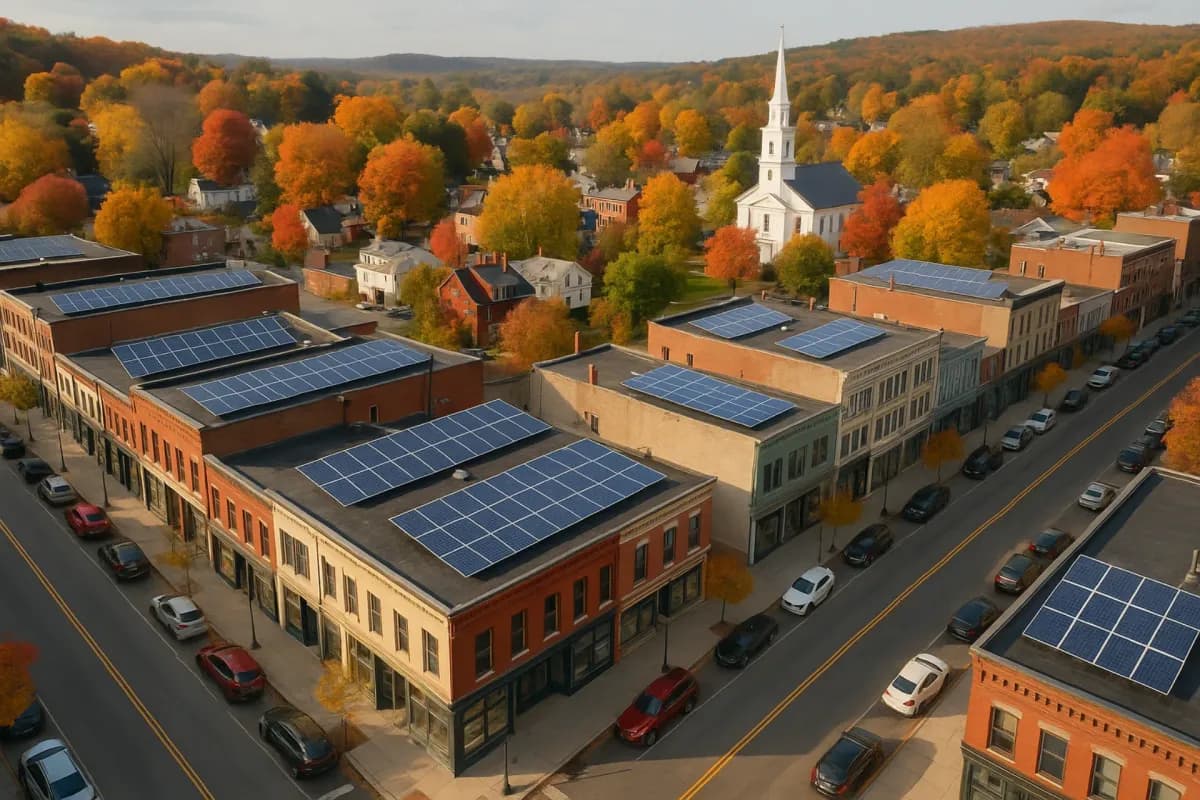
Plan roof, ground-mount, or carport solar from the property's real load, utility tariff, site constraints, and current program rules. In Vermont, NuWatt's in-house engineers design and install the project — a direct EPC, not a lead reseller.
Electricity value
Utility-specific
Rate class + interval load
Installed cost
Quote-specific
No statewide $/W inserted
Production
Site-specific
Geometry + shading model
Program facts
Source-dated
Official sources linked
Free address-based tool
Get a preliminary roof layout, panel count, system size, annual production range, and confidence grade before sharing contact details.
No account required to see your roof result
It can be, but the answer must be modeled from the facility rather than a statewide average. Use the serving utility and rate class, 12 months of usage, interval demand where available, a site-specific production model, the EPC quote, and only incentives the project can document. This page separates current official program facts from customer inputs and modeled results.
The Vermont decision brief
Separate the net-metering permit pathway from a Standard Offer power-sale proposal.
Vermont net metering and the Standard Offer program are distinct arrangements. Standard Offer uses its own solicitation process; it is not a general rebate for every rooftop.
Review the applicable Certificate of Public Good process and utility interconnection requirements. A site sketch does not establish approval to construct or operate.
Document metering, any group arrangement, and renewable-energy certificate ownership. Electricity bill savings and environmental claims require their own supporting terms.
The Section 48E begin-construction window closed July 4, 2026: projects that began construction on or before that date may use the longer continuity pathway. Commercial solar projects starting now generally must be placed in service by December 31, 2027. The statutory credit is 6%; it can increase to 30% when the applicable prevailing-wage and registered-apprenticeship requirements are met. Commercial tax credit guide →
IRS Notice 2025-42 · verified 2026-08-06The value comes from the facility's real load, tariff, site, and tax position—not a generic statewide payback.
Generating power on-site turns a variable grid charge into a fixed project cost you can model for the life of the system in Vermont.
Model the 6% statutory Section 48E credit, the increase to 30% when PWA rules are met, and 100% first-year bonus depreciation only when your tax team confirms eligibility.
Lower electricity spend flows straight to operating income — a durable line-item reduction, not a one-time rebate.
On-site clean generation supports emissions targets and the sustainability requirements tenants, investors, and municipalities increasingly ask for.
Program decision layer
Official program facts are separated from customer inputs and modeled results so a planning number cannot be mistaken for an approved incentive or a measured outcome.
Start with the serving utility, rate class, 12 months of usage, interval demand where available, and an engineer-reviewed site design. Statewide rate averages and generic payback claims are intentionally absent. State and utility programs are added only after current eligibility is confirmed for this address and system.
Official program fact
Government or utility source, linked and date-verified.
Customer input
Your bill, rate class, interval data, quote, and tax assumptions.
Site model
Roof or land geometry, production, shading, and interconnection review.
Verified outcome
Only measured project results are called outcomes; examples stay labeled as models.
Compare like with like
| Arrangement | Where the value comes from | Records to compare | Mistake to avoid |
|---|---|---|---|
| Net metering | Use the applicable utility credit treatment and project-specific adjustments. | Certificate of Public Good, utility tariff, size/siting category, meter and REC election. | Assuming identical credit treatment for every Vermont roof or automatically retaining RECs. |
| Group net metering | Distribute the permitted output under the group’s account arrangements. | Same-utility accounts, group agreement, allocations and applicable permit conditions. | Counting a group member’s assigned benefit again as revenue of the host. |
| Standard Offer | Evaluate a separate power-sale proposal under the applicable solicitation and contract. | RFP, selection, power-purchase terms, interconnection and CPG requirements. | Treating Standard Offer as an automatic rooftop grant or an add-on to a net-metering model. |
List cash compensation, utility bill reduction and REC ownership in separate columns. A contract that transfers the environmental attributes must not also support a claim that the host retained those same attributes.
Test the selected REC treatment, group allocation and interconnection cost using the actual permit and tariff version.
Program references—not an award or tariff determination: Vermont PUC · Net metering · Vermont PUC · Standard Offer
One in-house engineering and install team, from first analysis through commissioning.
We model your building's real usage, roof, and Vermont utility tariff, then engineer a system sized to your load and budget.
Our licensed crews handle permitting, interconnection, and installation, then commission and inspect the system so it powers up to spec.
At handoff your team gets production visibility through the manufacturer portal (Enphase or SolarEdge), backed by our workmanship warranty and support line.
Green Mountain Power
Burlington Electric
Vermont Electric Cooperative
Project economics
Bring the installed-cost quote, site-specific production, utility-specific energy value, operating cost, financing terms, and confirmed tax assumptions. This state guide does not insert its own cost or payback model.
Your numbers · one shared calculation engine
Keep the EPC cash price, usable electricity value and dated benefits separate. Nothing below is prefilled with a state rate, invented installation price or assumed tax credit. Results stay on this device; this worksheet does not upload your bill or create an inquiry.
For this state: List cash compensation, utility bill reduction and REC ownership in separate columns. A contract that transfers the environmental attributes must not also support a claim that the host retained those same attributes.
Start with the building
These are planning scenarios, not claims about completed installations. Use the questions to make your site assessment and installer proposals more specific.
What roof, structural, and electrical work is needed alongside the solar installation?
How do seasonal loads and the account arrangement affect the system’s useful size?
Who holds the property rights, utility account, permit, and environmental attributes?
The investment decision
Compare proposals on the same scope. Keep cash price, conditional benefits, and annual operating value separate so an attractive headline does not hide a missing cost.
| Decision input | Evidence to request | Check before relying on it |
|---|---|---|
| Installed project cost | An itemized EPC proposal | Roof work, switchgear, interconnection, and exclusions |
| Electricity bill value | Utility tariff + interval load | Self-consumed generation, exports, and remaining demand charges |
| Program compensation | Applicable rules + project award | Eligibility, permitted combinations, term, and payment timing |
| Tax or financing benefit | Project-specific professional review | Ownership, usable benefits, financing fees, and payment schedule |
| Long-term cash flow | A dated, transparent financial model | O&M, replacements, insurance, degradation, and financing |
Screen the site first. Final pricing, program eligibility, and savings still require verification.
Utility, tariff, site, and current program rules verified for the property before economics are modeled.
Utility, tariff, site, and current program rules verified for the property before economics are modeled.
Utility, tariff, site, and current program rules verified for the property before economics are modeled.
A defensible project cost comes from an EPC quote built on the roof or site, structural scope, electrical equipment, labor rules, interconnection work, and schedule. The calculator on this page requires the quoted cost rather than supplying a statewide per-watt average.
Site-specific pricing with exact incentive calculations. No obligation.